Where did this number come from?
Follow the result back through the Event, assumptions, rules, state and evidence that produced it.

Kindynos follows consequential systems through time. An Event marks a change. An Episode preserves a bounded development around that change. Consequence Chains trace particular analytical paths through an Episode. Stories connect multiple Episodes into larger developments.
Everything starts with the Event. An Episode is a collection of Events and their consequences. These are related objects, not interchangeable labels: the Event marks change; the Episode preserves the bounded development; a Consequence Chain follows one path through it; a Story composes Episodes when the larger development cannot be represented cleanly as one Episode.
A represented occurrence, trigger, decision or state-changing development.
A bounded development through time containing changing state, Events, mechanisms, decisions, outcomes, evidence and uncertainty.
A selected analytical path through an Episode showing how one change reaches another.
A composition of one or more Episodes whose interactions matter at a larger scale.
An Episode is not simply a list of consequences. It is a bounded region of a larger history in which several continuing parties and assets interact materially. A bank, borrower, market, asset or regulator exists before the Episode begins and continues after it ends.
A Consequence Chain can cross several of them without becoming the whole Episode.
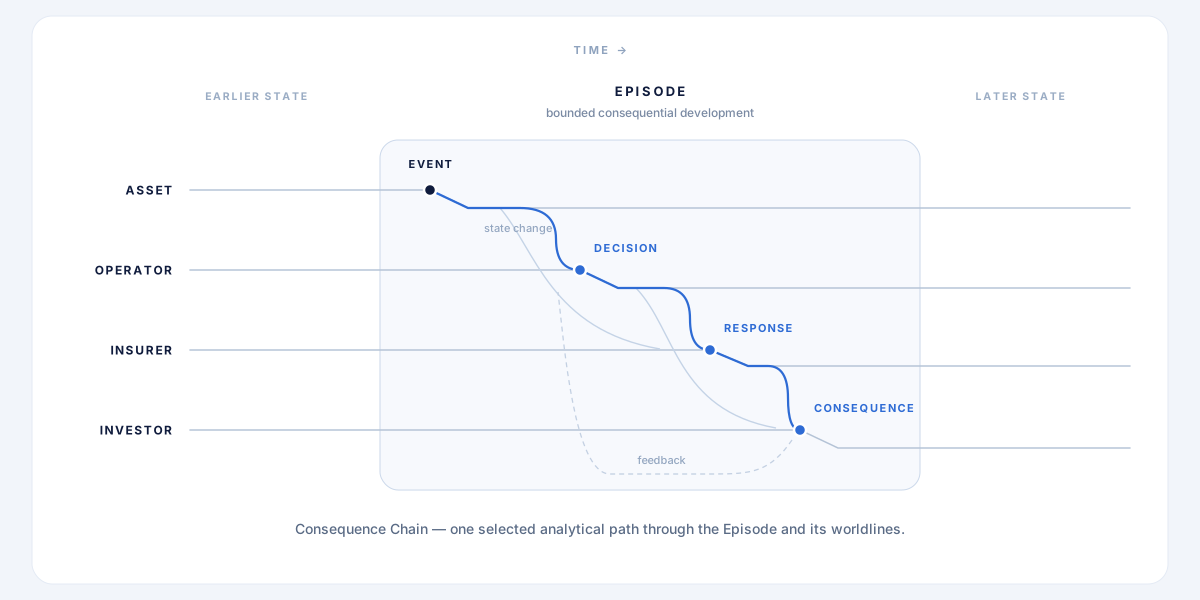
During heat stress, a chiller fails. Equipment, building operations, insurance, property economics and several stakeholders continue through the same bounded development. The verified calculation below follows selected consequence paths through that development; the Episode is larger than any one path.
Heat stress raises the modeled risk of chiller failure. The chiller fails and its modeled value falls by $163k. The cooling outage affects building operations and income. The business-interruption insurer pays a $1.18M claim, and the property's modeled value falls by $62.0M. The building owner loses $1.0M and the corporate tenant loses $3.0M, while the emergency-service vendor gains $25k. The analysis also represents a feedback path in which financial pressure can lead to deferred maintenance and a higher risk of another failure.
| Result | Calculation used | Technical source |
|---|---|---|
| Chiller value change | Asset replacement-cost calculation | AssetReplacementCostModel v0.14.0 |
| Property value change | Real-estate income calculation | RealEstateIncomeModel v0.14.0 |
| Building owner | Owner income-shock calculation | stakeholderkit::BuildingOwnerNOIShockModel |
| Corporate tenant | Business-interruption calculation | stakeholderkit::TenantBusinessInterruptionModel |
| Emergency-service vendor | Emergency-service revenue calculation | stakeholderkit::VendorEmergencyServiceRevenueModel |
| Business-interruption insurer | Insurance-claim calculation | stakeholderkit::InsurerBusinessInterruptionClaimModel |
| Building staff | Overtime-wage calculation | stakeholderkit::WorkforceWageImpactModel |
| Technical run | engine10::1536120982797318b09363be82411391 · seed 42 · 2026-06-30 | |
Additional verified outcome: the same run includes +$24,000 of building-staff overtime. The primary diagram shows selected stakeholder outcomes; this additional result is retained in the evidence layer.
Deeper architecture: technical formalism.
One Episode can contain several Events, multiple consequence paths, decisions, interventions, feedback and unresolved relationships. The Episode keeps those elements together without pretending that every relationship is causal or that every missing relationship is zero.
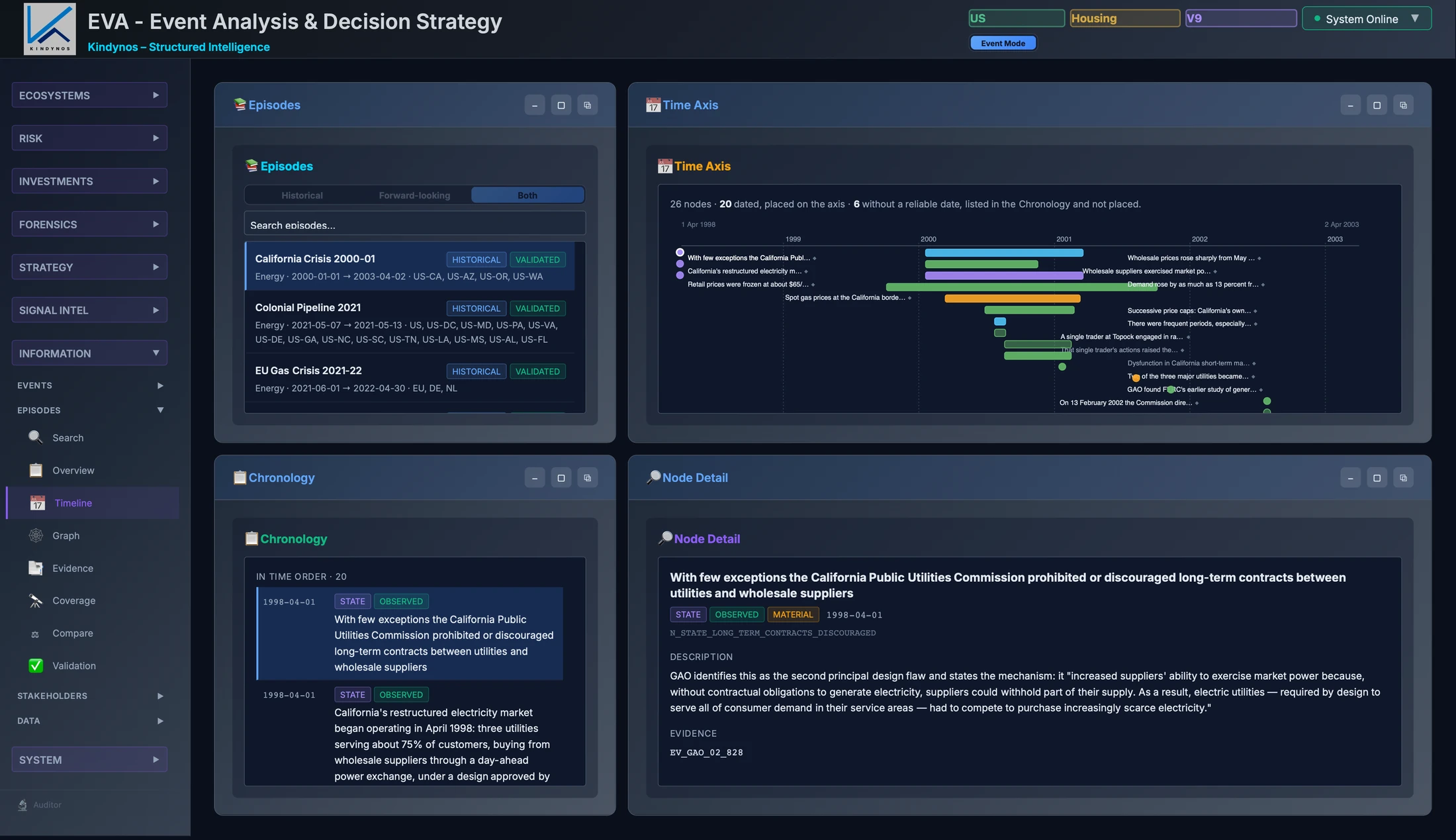
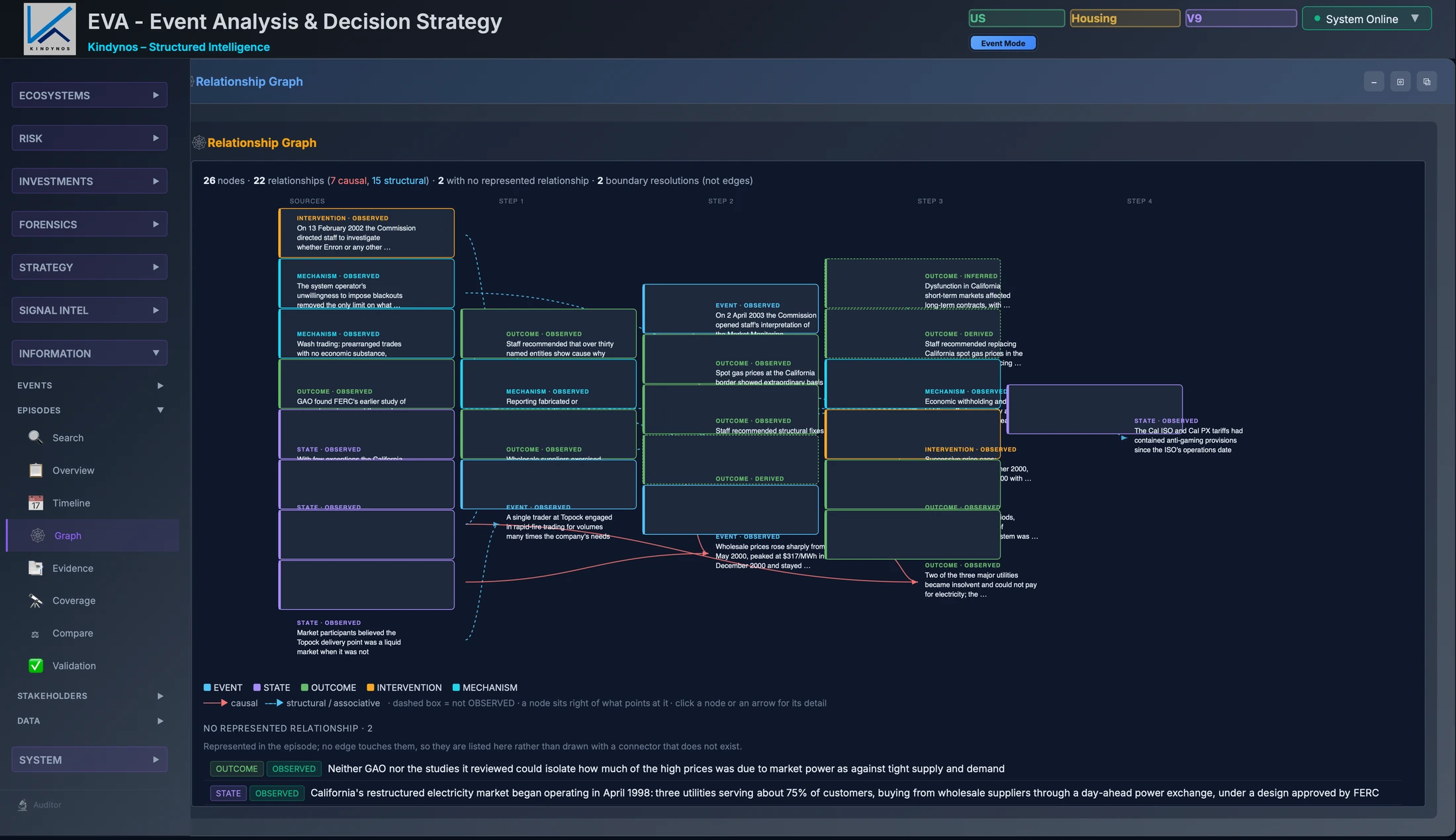
Historical Episodes preserve evidence-linked developments: what happened, when it happened, what changed, what was decided, what outcomes followed, and what remains uncertain or contested.
Prospective Episodes represent possible developments from a stated current state and Event. They are model outputs, not historical facts, and their dependencies and limits remain explicit.
Different questions produce different paths through the same bounded development. A chain can move forward from an Event, backward from an observed outcome, compare an intervention, or expose a feedback loop.
Follow the result back through the Event, assumptions, rules, state and evidence that produced it.
Change a decision or assumption and compare what follows — where the model supports that alternative.
Work backward from an observed result to represented paths consistent with the evidence without declaring one path automatically "the cause."
Inspect the inputs, rules, calculations, dates and source material behind the result.
Technical readers can inspect the formal definitions in the technical formalism.
Not every relationship or consequence can be calculated. If required evidence is missing, Kindynos says what is missing. If no rule or model supports the next step, it gives no result. It does not fill the gap with a plausible-sounding number. For example, in the event presented here there was no result for the lender, because no rule in that model connects the Event to a lender.
Kindynos keeps the calculation trail behind material results: what happened, what information was used, which rule or model was applied, and when the calculation was made. Historical assertions, prospective model outputs and unresolved relationships remain distinguishable.
Technical readers can inspect model versions, calculation receipts and the deeper integrity design in the technical formalism.
Financial pressure can lead to deferred maintenance. Deferred maintenance raises the risk of another equipment failure. Another failure creates more financial pressure. The result is a loop, not a line. An Episode can preserve that feedback rather than ending at the first downstream result.
Episodes do not have to occur one after another. They can overlap, run in parallel, recur, or interact across different threads. Story is the higher-order composition used when the larger development cannot be represented cleanly as one Episode.
Status: Episode Intelligence is implemented and under validation. Story is the higher-order architecture now being developed and should not be read as a claim of completed Story functionality.
Start from an Event, an Episode, an observed outcome or a decision. Kindynos follows the represented development, exposes selected consequence paths, preserves the evidence, and says where the analysis stops.