
What Kindynos can do.
Kindynos applies different analytical functions within a represented ecosystem: trace consequence, compare decisions, reconstruct what happened, and interpret new information as conditions change.
Different questions. One ecosystem. Shared analytical discipline.
Each capability connects to named examples and the evidence that supports the ecosystem inputs and results.
Consequence
What changes, and who bears it?
Decision
What action changes the path?
Forensics
What happened, and by which route?
Intelligence
What is changing, what is exposed, and what does it imply?
Signals
What outside information corresponds to a modeled event?
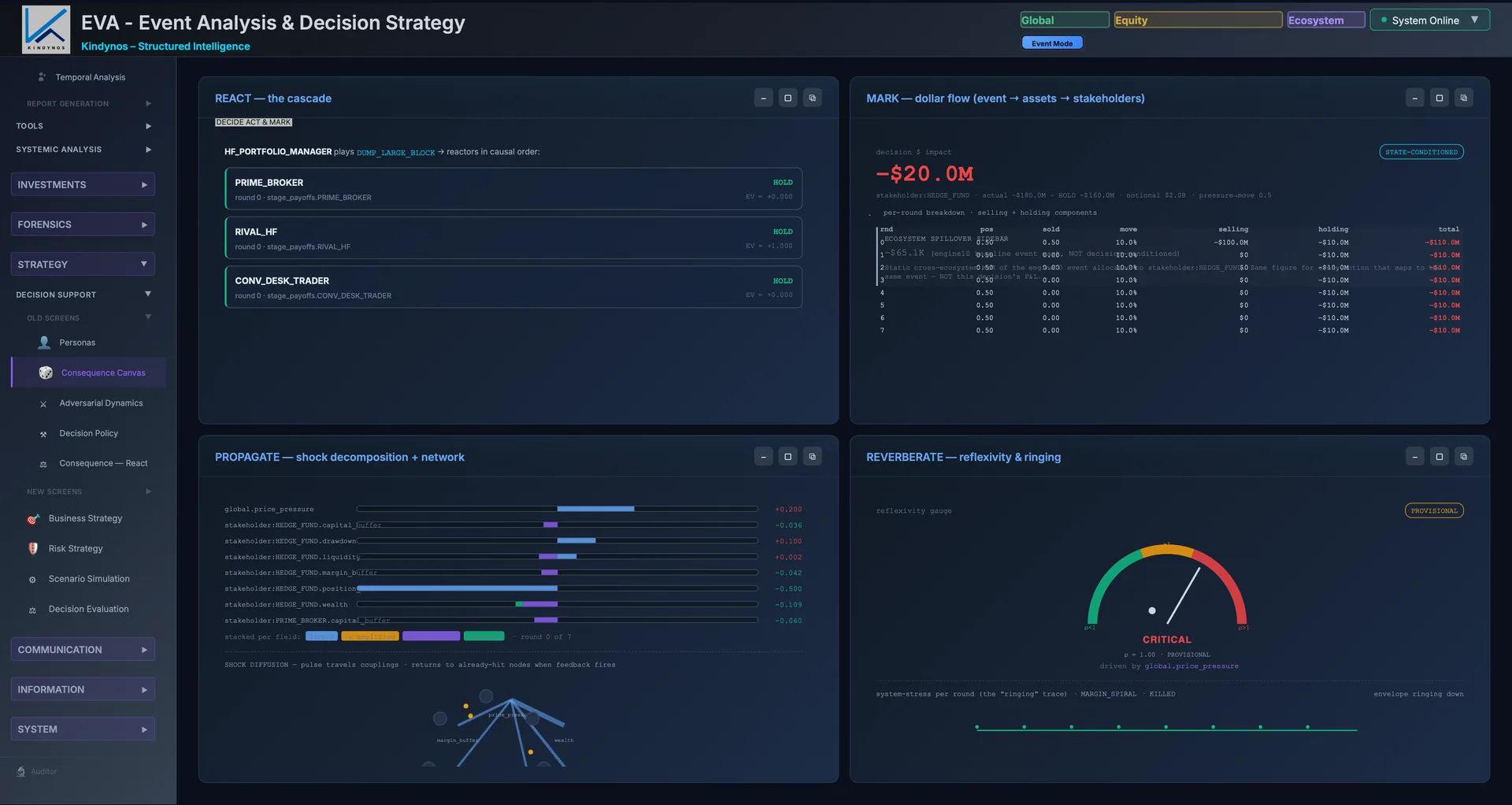
What changes, and who bears it?
Follow a concrete event through changes in ecosystem conditions, affected assets, relationships and obligations, and stakeholder consequences, applying the relevant models without collapsing different stakeholders into one severity score.
- Consequence and stakeholder-incidence analysis
- Risk and accumulation analysis
- State-contingent valuation
- Allocation across obligations, claims and stakeholder interests
One building loss. Two economic bearers.
What action changes the path?
Compare an immediate action with decisions that play out over time, including changes in ecosystem state and reactions by other stakeholders. A decision is an intervention that can alter the future path, not another event category.
- Decision analytics
- Simulation and scenario analysis
- Multi-period policy evaluation
- Strategic and adversarial response
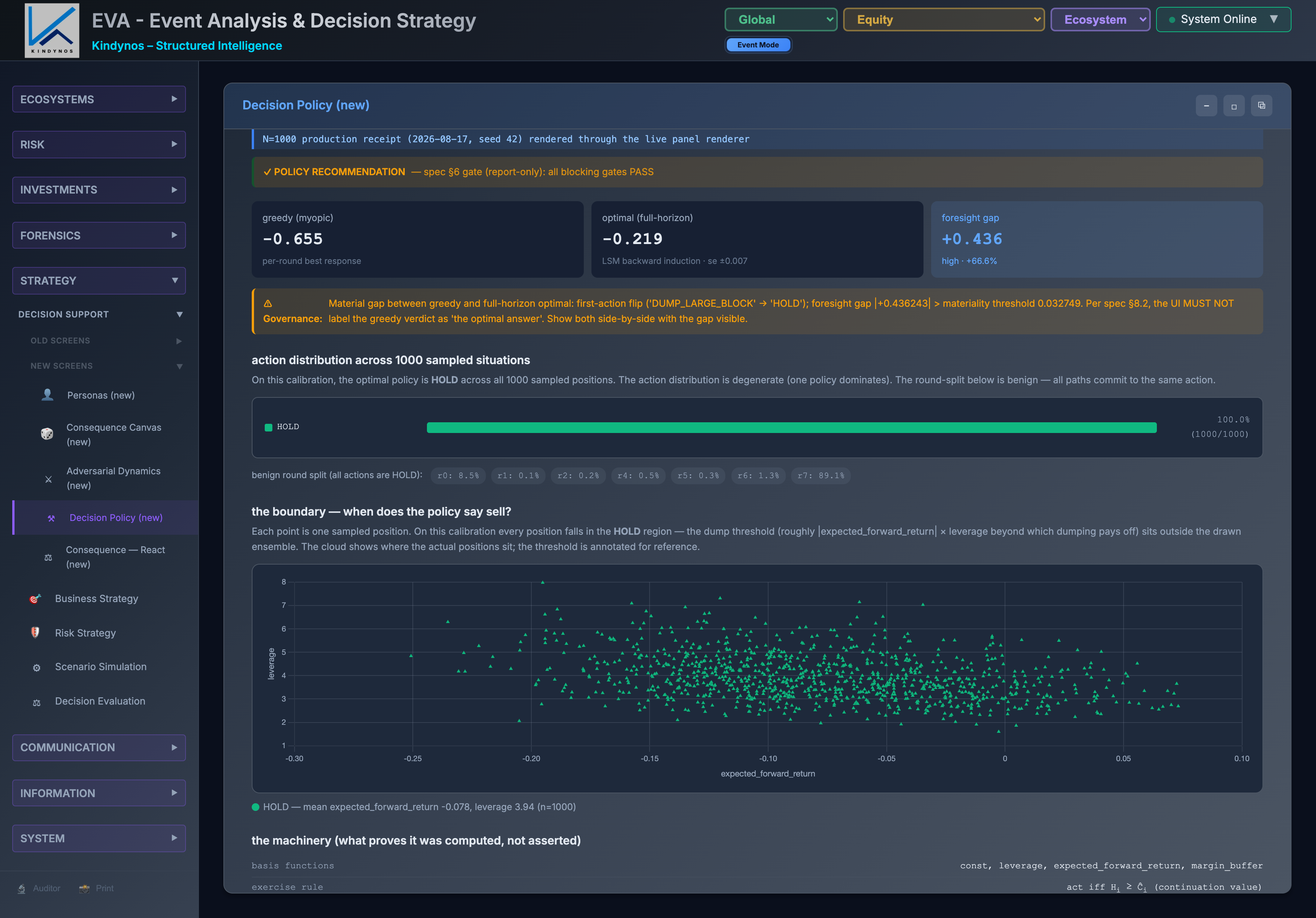
What happened, and by which route?
Start from an observed outcome and work backward through candidate causes, earlier changes in ecosystem state, applicable rules or obligations, model assumptions and evidence, while keeping alternative explanations visible.
- Forensic reconstruction
- Evidence and provenance
- Reconciliation and replay
- Alternative-cause and obligation analysis
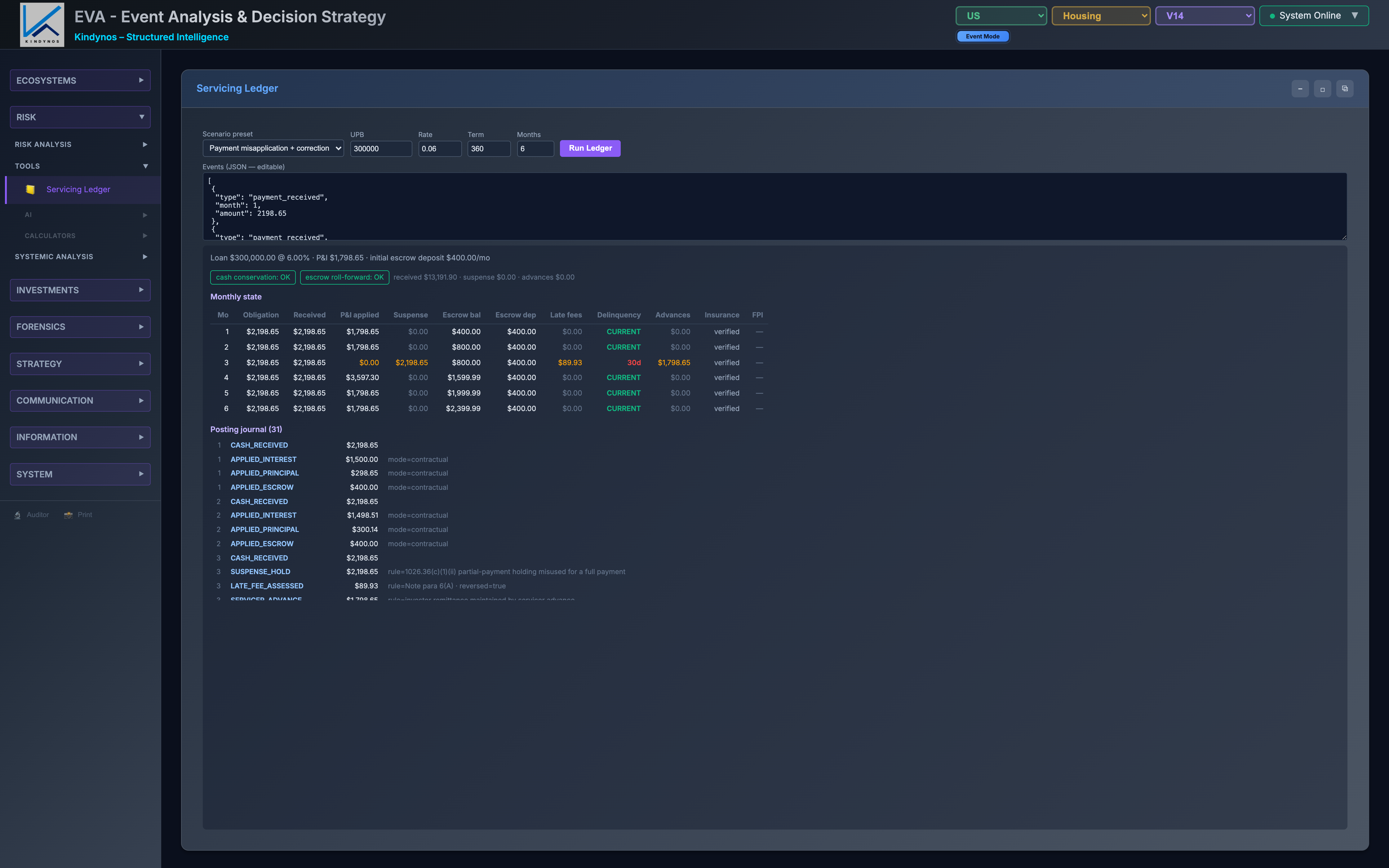
What is changing, what is exposed, and what does it imply?
Connect events and changing evidence to issuers, instruments, portfolios, dependencies and candidate responses.
- Monitoring and event intelligence
- Investment intelligence
- Portfolio and exposure analysis
- Look-through and forecasting where supported
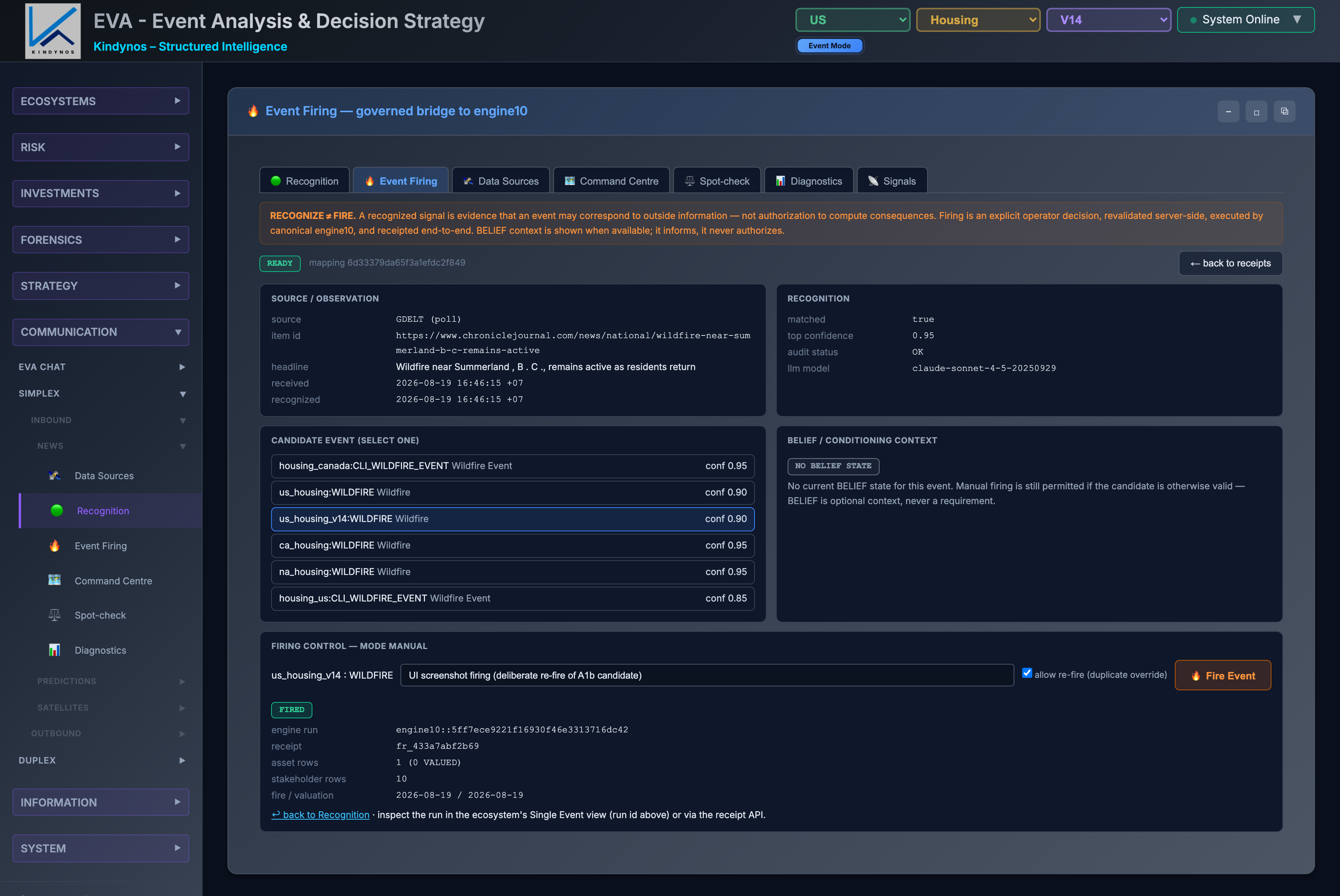
What outside information corresponds to a modeled event, and how does it enter analysis?
EVA can monitor selected public sources, preserve provenance, map an external item to candidate modeled events, and let an operator explicitly fire a validated match through the canonical analytical path. Recognition itself does not compute impact or authorize firing.
- Selected public-source ingestion with source identity, timestamps and provenance
- Candidate-event recognition with confidence and explicit NO_MATCH outcomes
- BELIEF and prediction-market context, with declared conditioning where an authored mapping exists
- Explicit operator-authorized firing through the canonical analytical path
- Typed refusal, duplicate protection and end-to-end firing receipts
Capabilities connect to named analytical paths.
Each example shown on the site identifies the ecosystem, the event, the affected assets and stakeholders, the result and the supporting evidence.