Mortgage Finance
Loans, servicing, guarantees, pools, structured securities and contractual cash-flow state.
See verified mortgage evidence →
Financial events originate here—and consequences from supply chains, cyber incidents, regulation, insurance, energy and physical systems can arrive here as changes in cash flow, credit, capital, securities, portfolios and decisions.
Conventional risk systems are powerful at current exposures, factors and scenarios. Harder cases depend on path, contract state, sequence, optionality, accounting treatment and who is allowed to act next. Event Intelligence keeps those transitions explicit instead of compressing them into a single shock vector.
Finance connects represented events to contractual state, positions, stakeholder incidence, valuation and decision consequence across the full path.
Each keeps the objects, state and models the problem requires, rather than a shared abstraction imposed across all of them.
Loans, servicing, guarantees, pools, structured securities and contractual cash-flow state.
See verified mortgage evidence →Issuers, securities, derivatives, portfolios, market events and investment decisions.
See verified Equities evidence →Broader portfolio, credit, commodities and related financial systems remain separately represented according to their available models and evidence.
Consequence analysis brings together typed entities and objects, concrete state-changing events, explicit relationships and stakeholder-indexed outcomes.
Consequences can branch, create new events, and differ in sign and magnitude across stakeholders. Kindynos keeps those branches, relationships and unresolved outcomes visible.
The Housing evidence starts with the represented mortgage, servicing or programme state. The event changes that state first; valuation, cash, liability and capital consequences follow according to the rights and obligations each financial position actually carries.
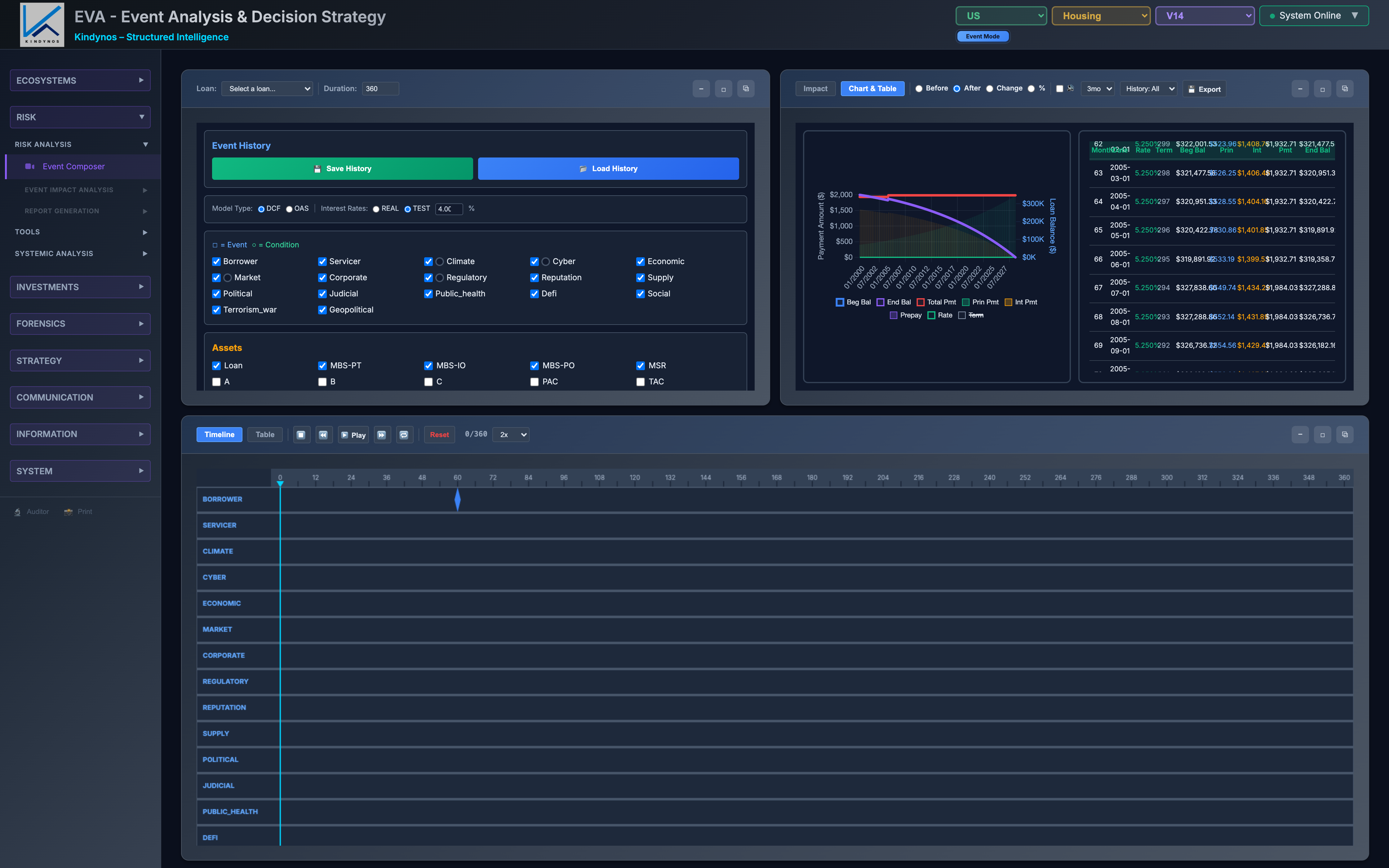
A declared six-month forbearance creates servicing advances, an explicit interest-capitalization posting and a re-amortized loan schedule before downstream positions are revalued.
US_HOUSING_V14 · POST /api/v1/cashflow/apply-events · halo_events
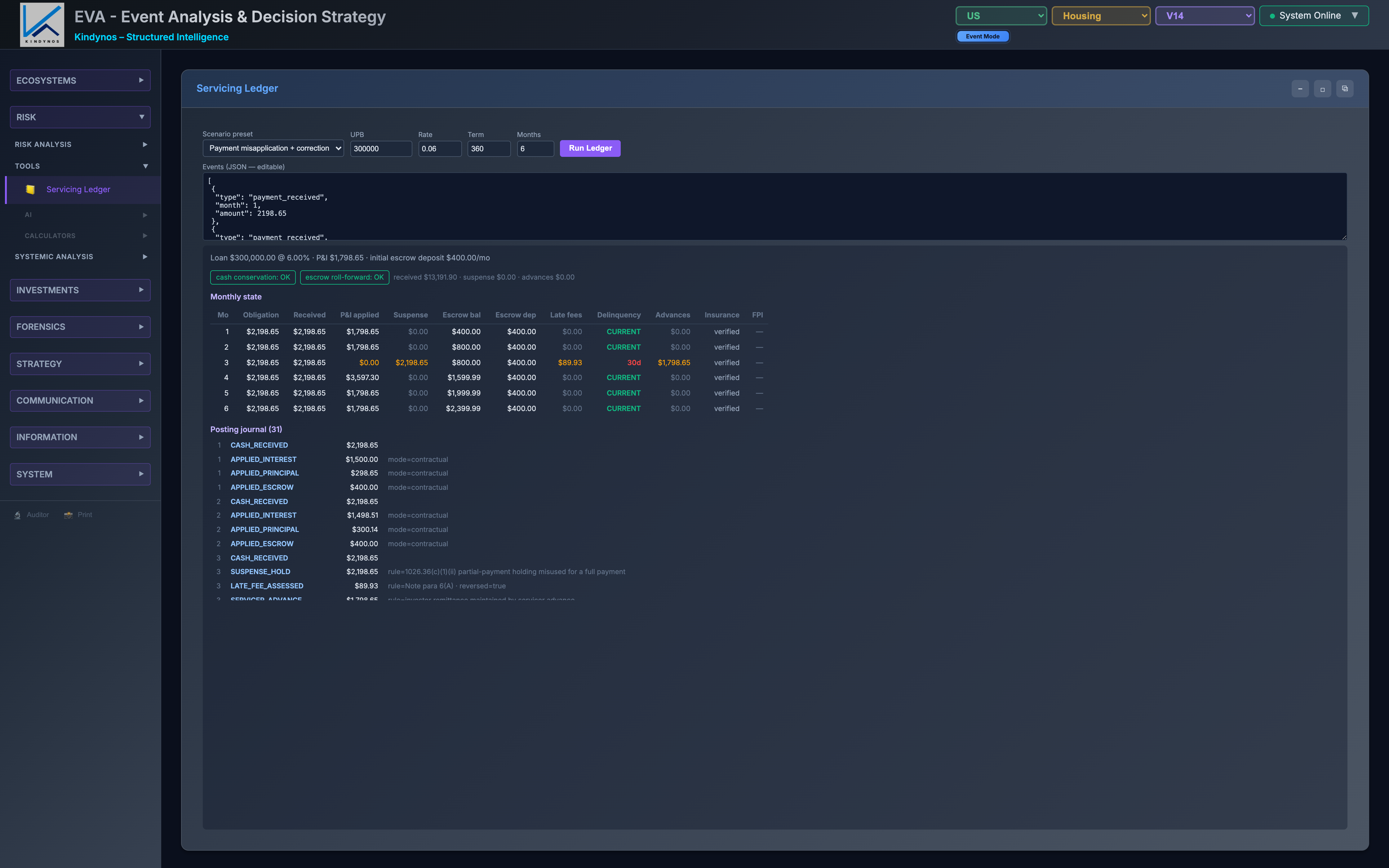
The borrower sends the same cash in both paths. An erroneous application state creates suspense, false delinquency, a late fee and a servicing advance; the correction event reverses the consequences.
POST /api/v1/servicing/ledger/run · halo_events
One payoff is accounted for differently across principal-bearing assets, servicing rights, guarantee-fee streams and contingent guarantee capital. Position extinction is kept distinct from economic loss.
us_housing_v9 · POST /api/v1/firing/fire-event · engine10
Loan balance, borrower liability and VA entitlement remain distinct state variables across release and substitution branches.
Review case →Coverage state, notice chronology, escrow obligation, deterioration, improper placement and refund are represented on one servicing path.
Review case →Familiar IO/PO and tranche behavior acts as an answer key for cash-flow propagation rather than a claim of novelty in prepayment analytics.
Review validation →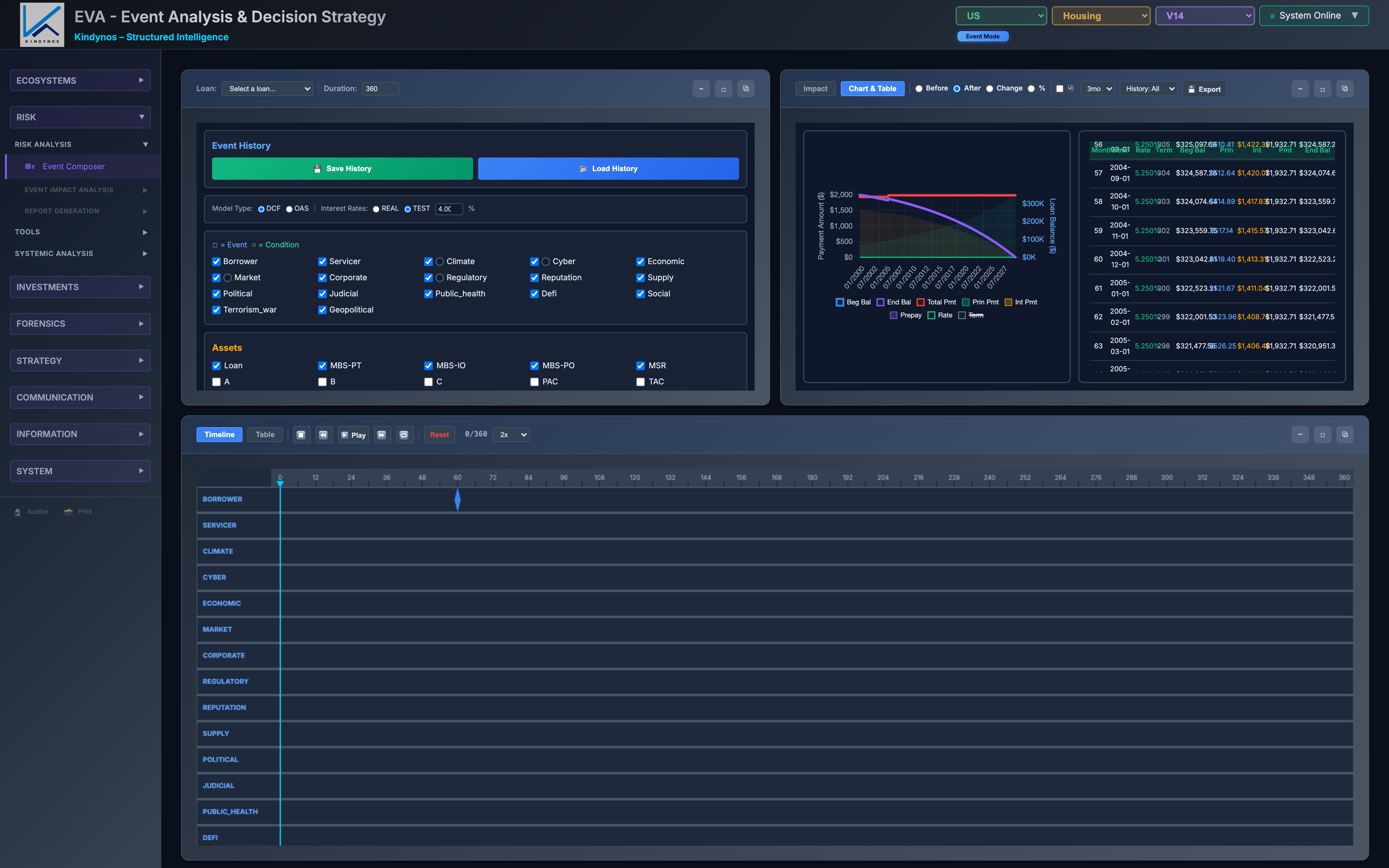
In the verified fire-sale case, the myopic optimizer dumps a large block and backfires. A full-horizon Longstaff-Schwartz policy holds. The first-action difference remains at 1,000-path evaluation.
All 8 declared policy gates pass. The result is presented as a scenario-specific policy recommendation with the optimizer disagreement visible.
Review the evidence frame →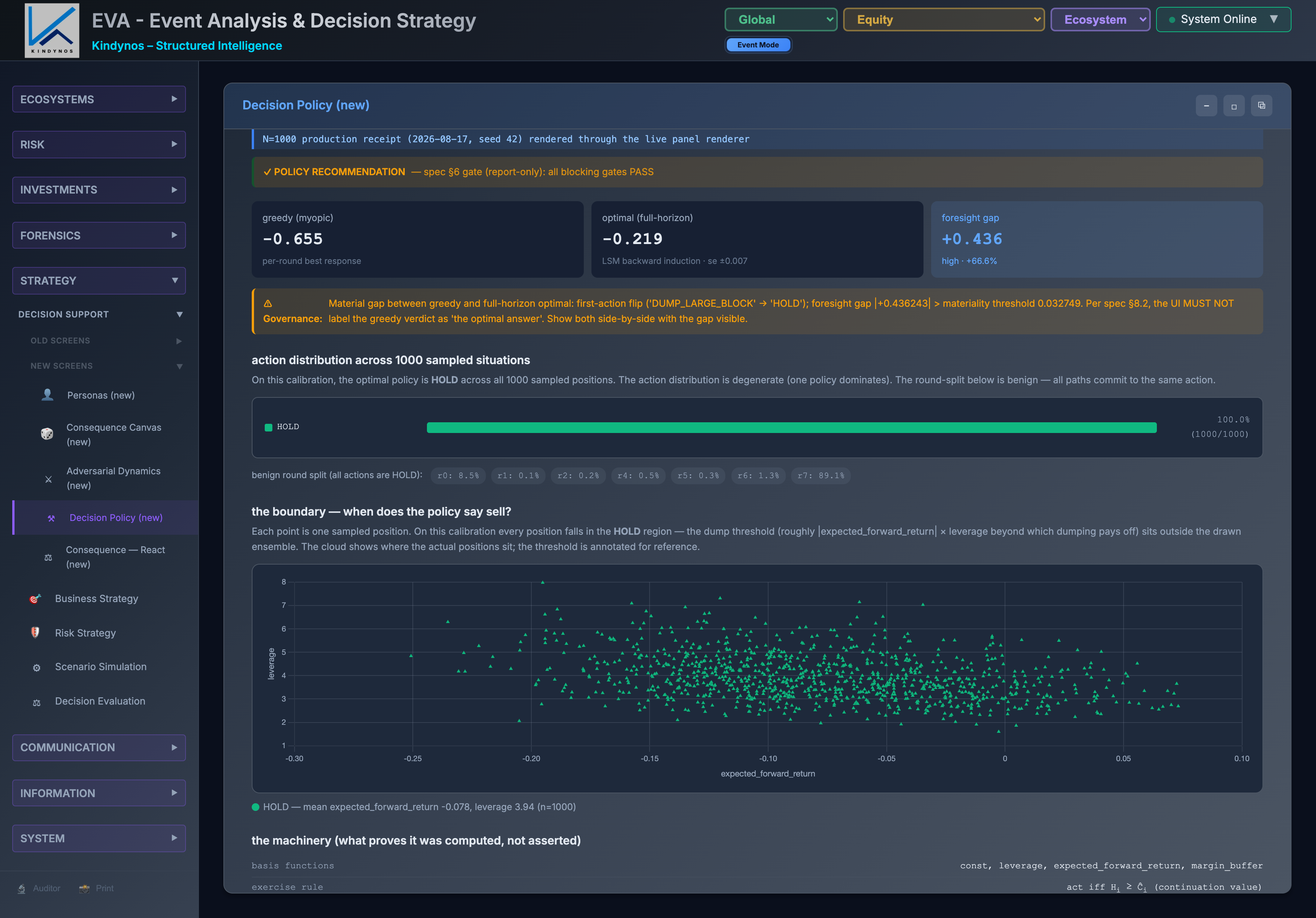
A single cited cyber event fires against common equity, a convertible and options. Each instrument is valued through its own model, so the consequences differ in magnitude and sign.
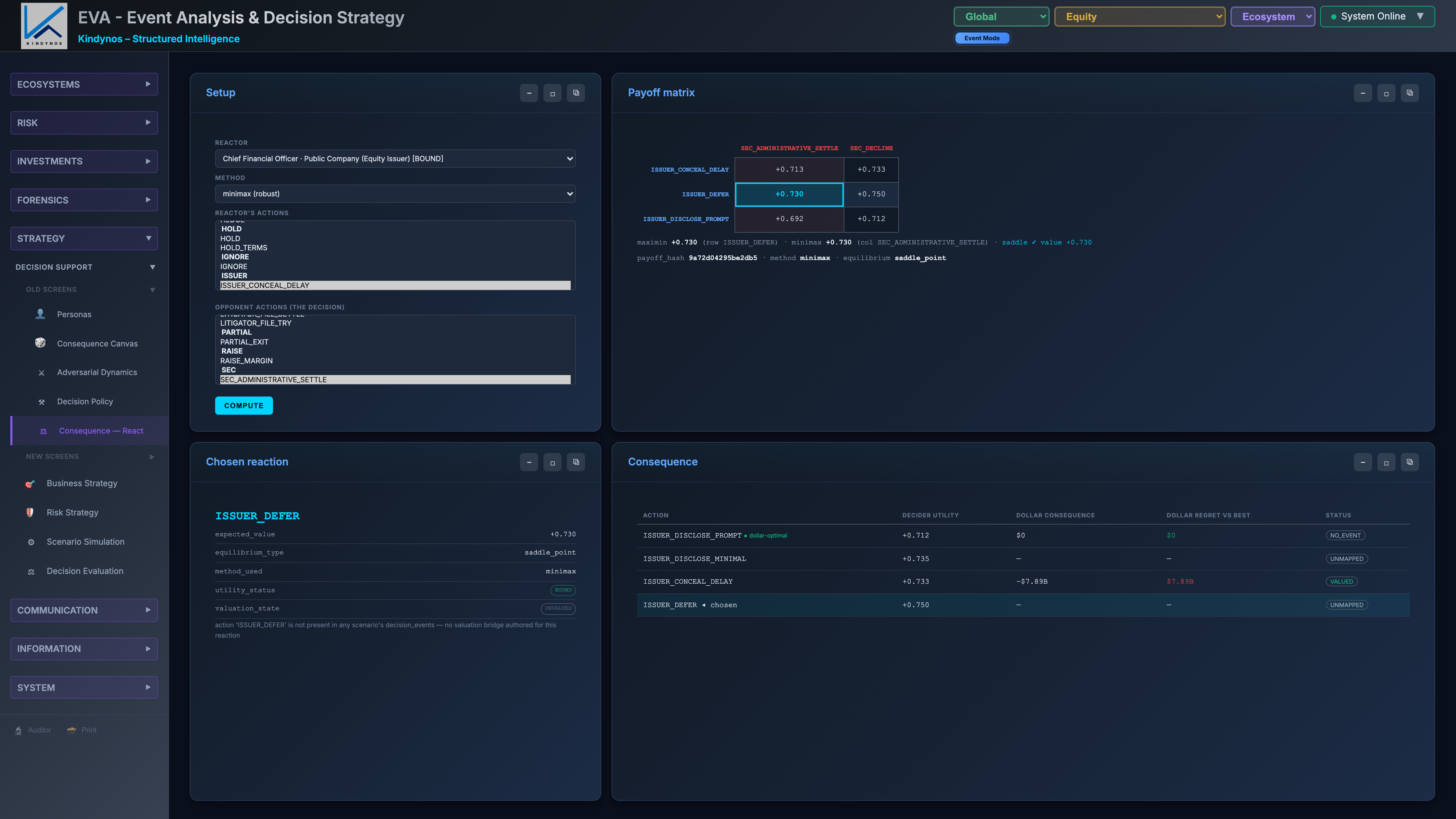
In a CFO-versus-regulator decision case, Kindynos computes the focal actor's pure-strategy minimax response while preserving the regulator objective as explicitly unvalued.
maximin = minimax
The action space remains in the game while an unsupported utility function remains unassigned.
Finance & Banking includes represented ecosystems for U.S. Housing and Mortgage Finance, global equities and broader portfolio analysis. The evidence connects those ecosystems to named execution paths and visible results.
Start with a focused position set and an event whose consequence depends on contract, path, stakeholder structure or decision state. Reproduce known position-level effects, reconcile the path, compare responses and keep unresolved branches visible.