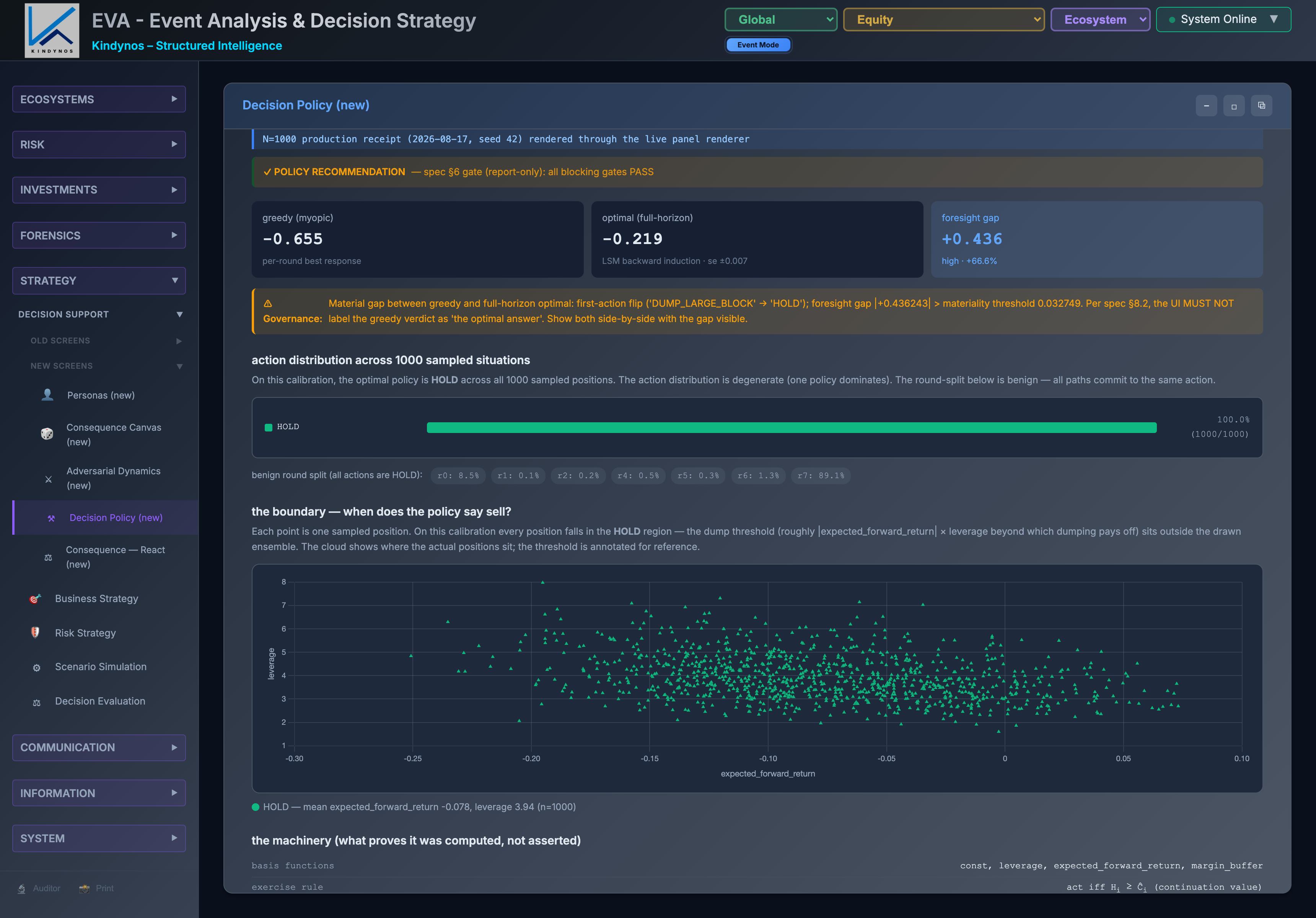
Myopic: DUMP. Full horizon: HOLD.
+0.436foresight gap · N=1000
Different time horizons produce different first actions in the verified fire-sale case.
Explore the case →
Public cases connect named events to positions or stakeholders, visible numbers and analytical context. Four cases extend that view into technical verification.
Each public case identifies the ecosystem, version, event path and result that support the claim.
Screenshots and case studies show the visible result and analytical context; technical verification traces four cases into the underlying execution record.
Each case proves a different reason the same event can produce different economic consequences.
Different time horizons produce different first actions in the verified fire-sale case.
Explore the case →Convertible, call and put positions revalue through their own instrument models.
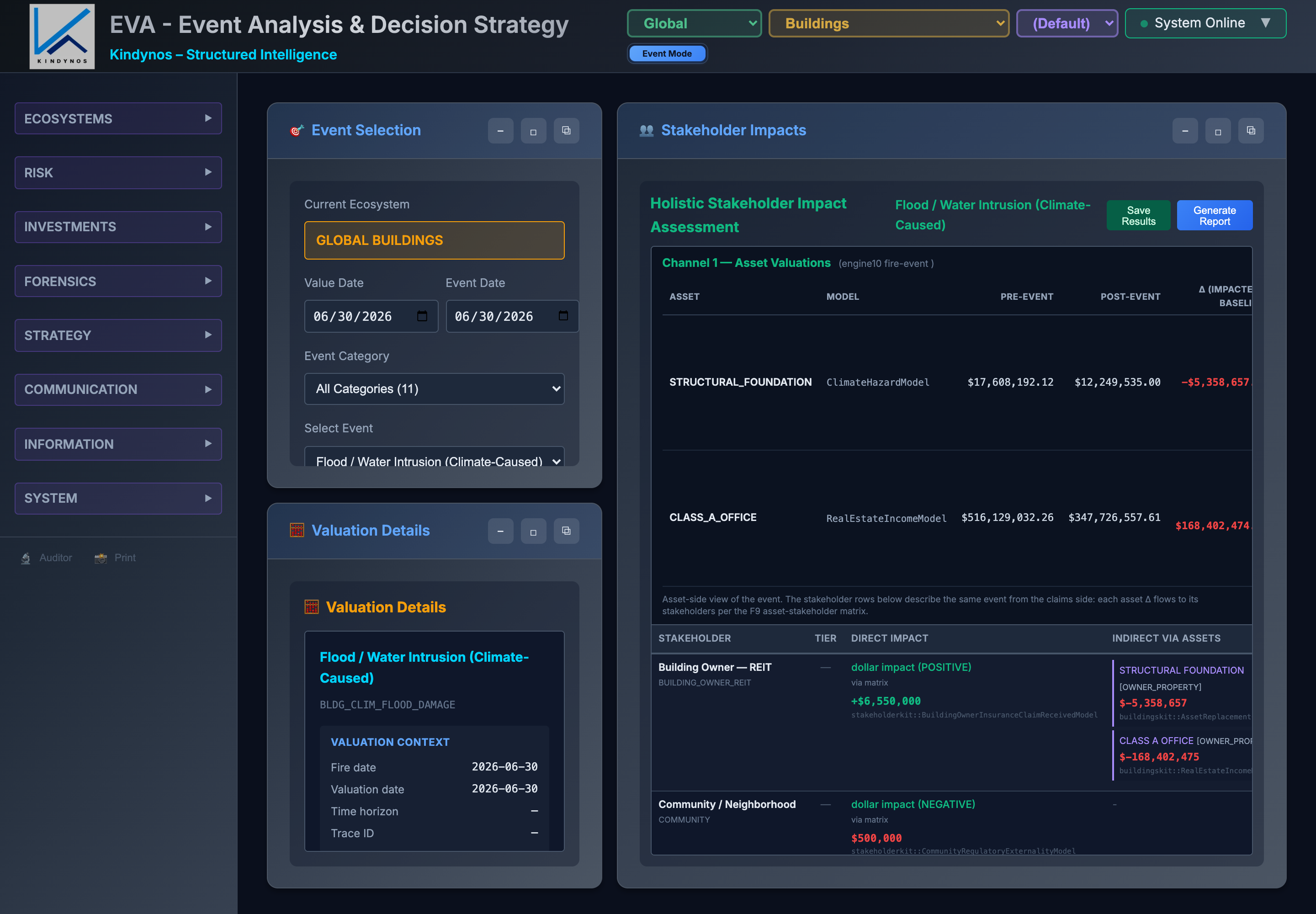
Explore the case →Recovery to the building owner equals the insurer claim payment exactly.
Explore the case →Three parallel reinsurance counterparties carry $130M each.
Explore the case →Retention and sublimits transform the declared incident scenario.
Explore the case →The CFO objective is modeled while the regulator utility remains explicit as UNVALUED.
Explore the case →These panels are tied to the same named evidence paths used for the public claims.
In the demonstrated path, a real public-source item was ingested with provenance, recognized as a candidate WILDFIRE event in the US Housing v14 ecosystem, reviewed by an operator, and explicitly fired through EVA's canonical Engine10 path. Recognition itself did not authorize the run.
engine10::5ff7ece9221f16930f46e3313716dc42fr_5d1bb6e738e2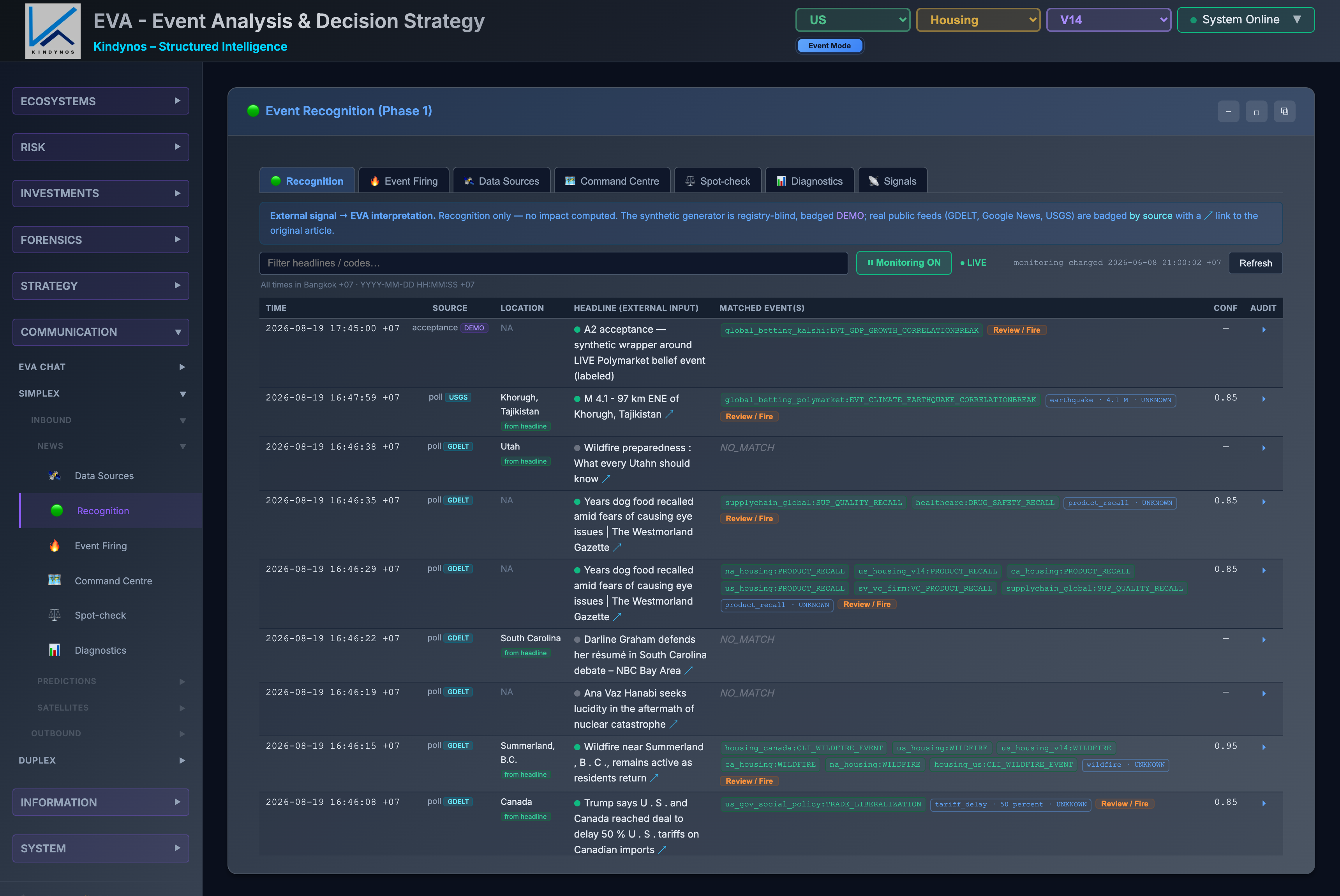
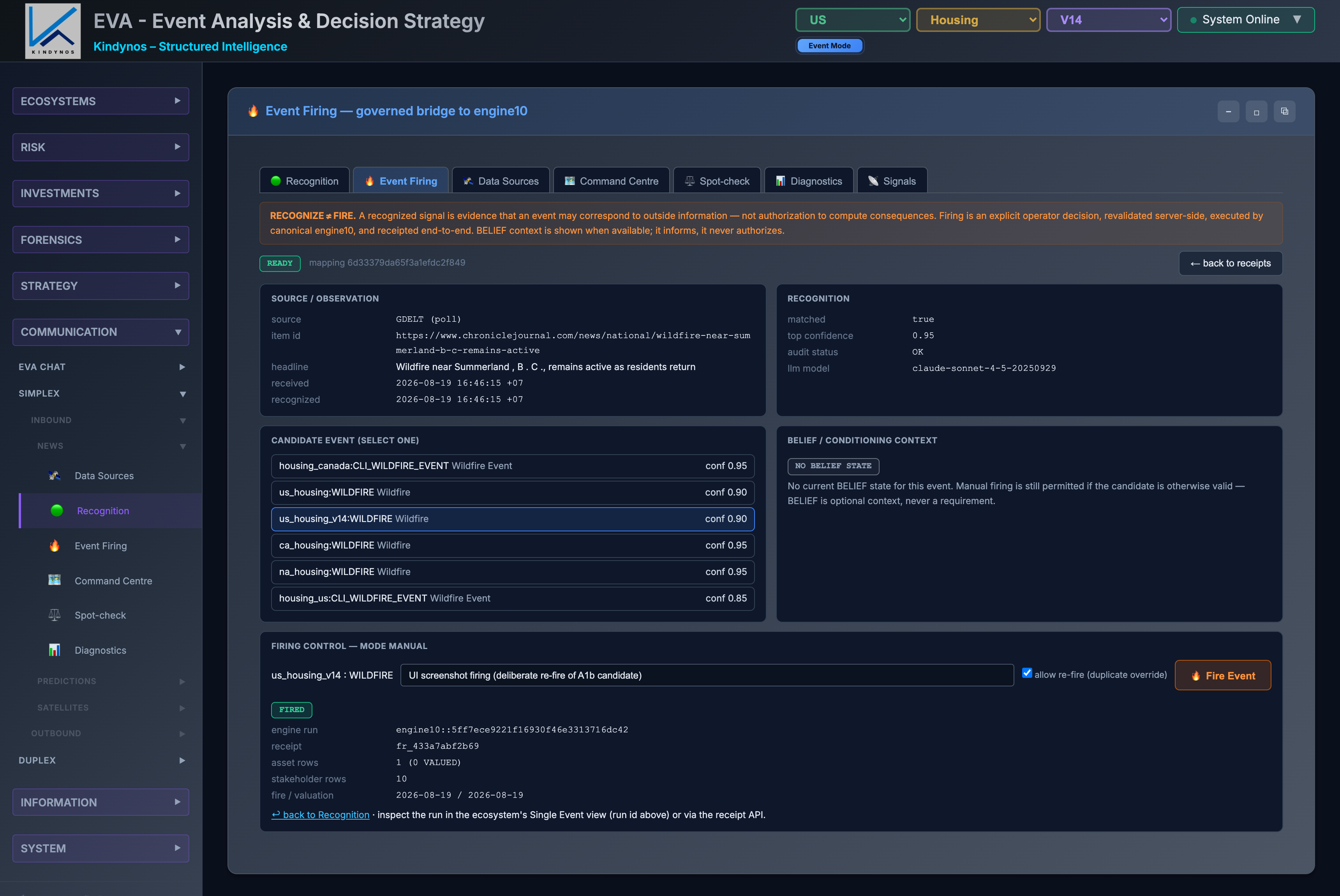
A real public-source item that did not map to a modeled event was refused as NO_MATCH_NOT_FIREABLE; no Engine10 run was created. A duplicate firing attempt is also refused unless a deliberate re-fire override is supplied.
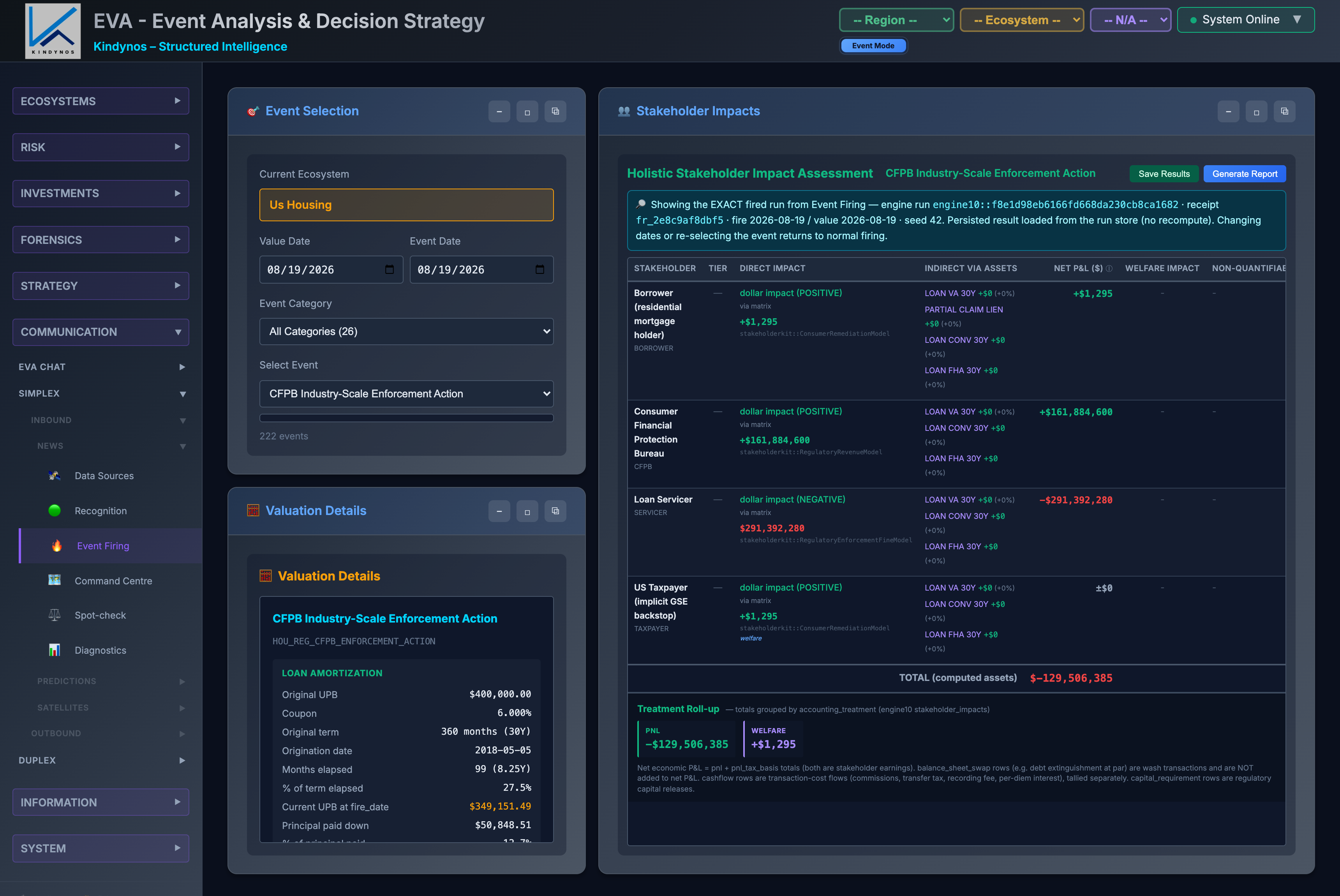
A separate controlled proof used a labeled prediction-market fixture. The market-side probability did not directly determine consequence. EVA applied a declared modeling rule that mapped the fused belief value into an Engine10 condition, and stakeholder models consumed that condition.
HOU_REG_CFPB_ENFORCEMENT_ACTION · US Housing v9
Servicer −$180.0M
CFPB +$100.0M
Borrower / taxpayer +$800 each
run engine10::3797452967d123fc0d71ad375ac79f55
p_fused = 0.618846 → regulator_enforcement_posture = 1.618846
Servicer −$291.392M
CFPB +$161.885M
Borrower / taxpayer +$1,295.08 each
run engine10::f8e1d98eb6166fd668da230cb8ca1682
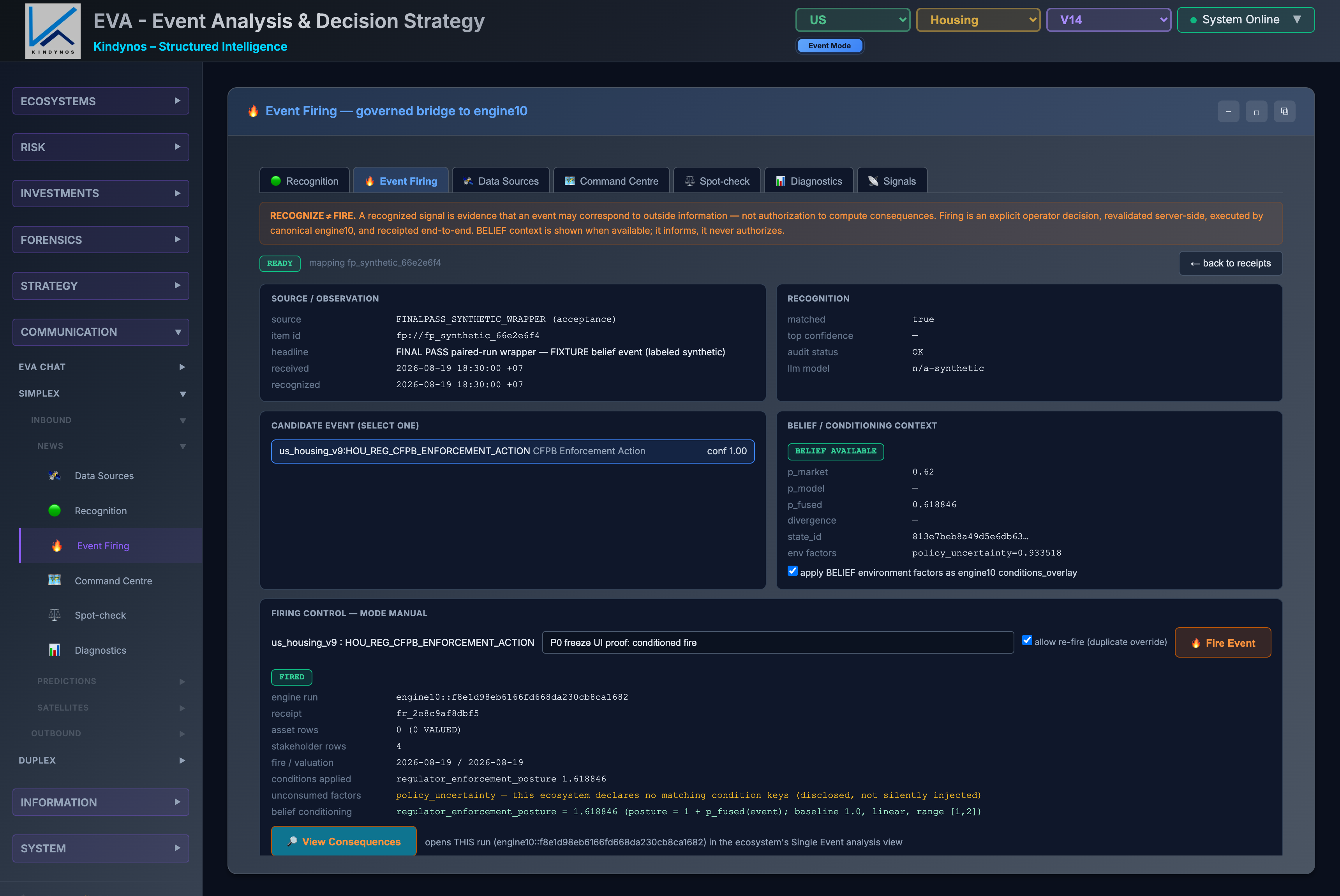
The Housing evidence family shows state transformation, operational consequence and contractual incidence across several named execution paths.
Forbearance Lifecycle. Servicing advances, interest capitalization and re-amortization change the represented schedule before six downstream positions are revalued.
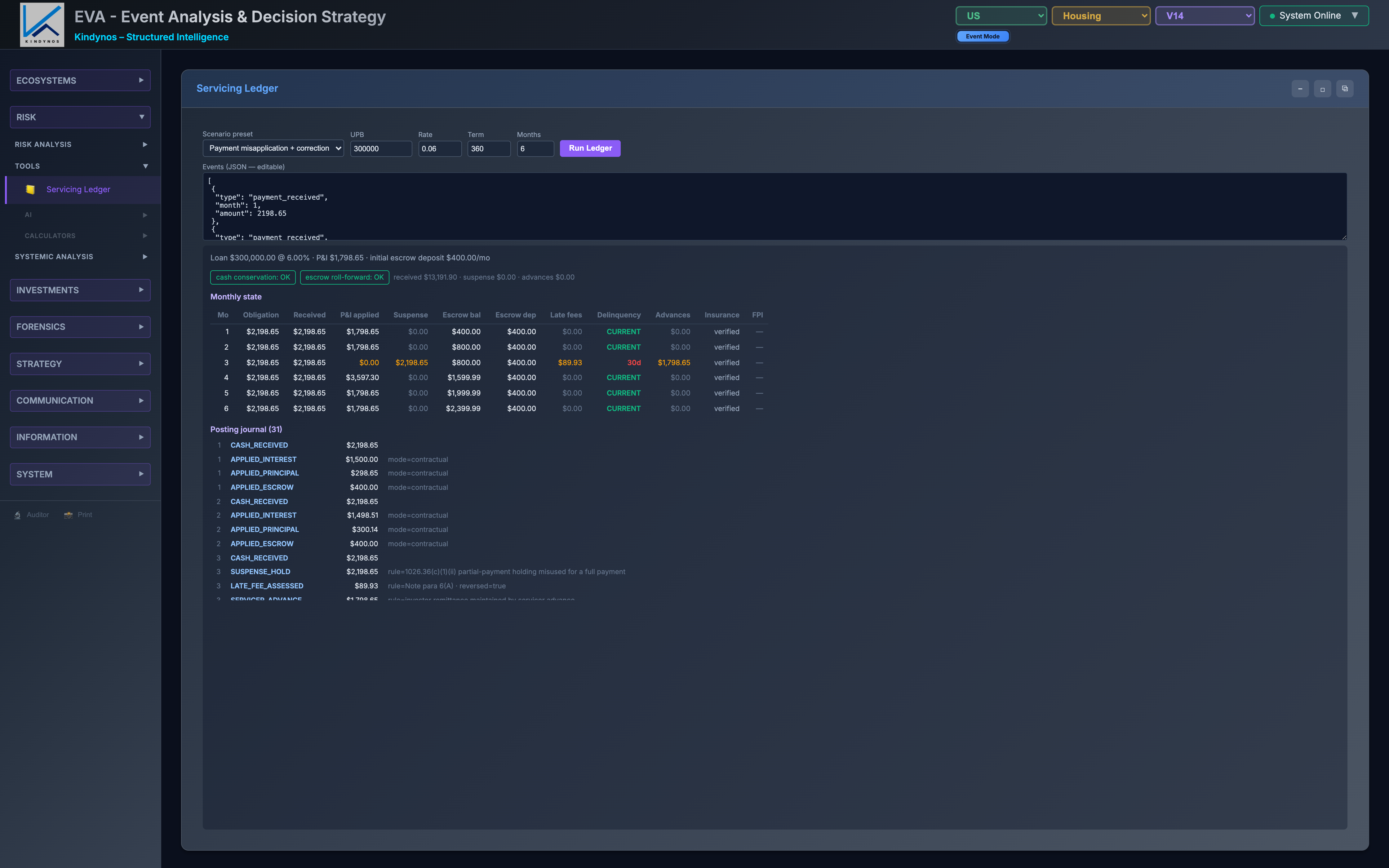
Payment Misapplication. Cash received is held constant; erroneous application creates suspense, false delinquency, a late fee and a servicer advance before correction restores the account.
Agency & Guarantee Payoff. Principal redemption, premium P&L, fee-stream termination and capital release remain separate accounting consequences.
These operator captures show application behavior across US Housing, Global Equity, Global Buildings and Global Insurance, linking visible interfaces to named analytical paths.
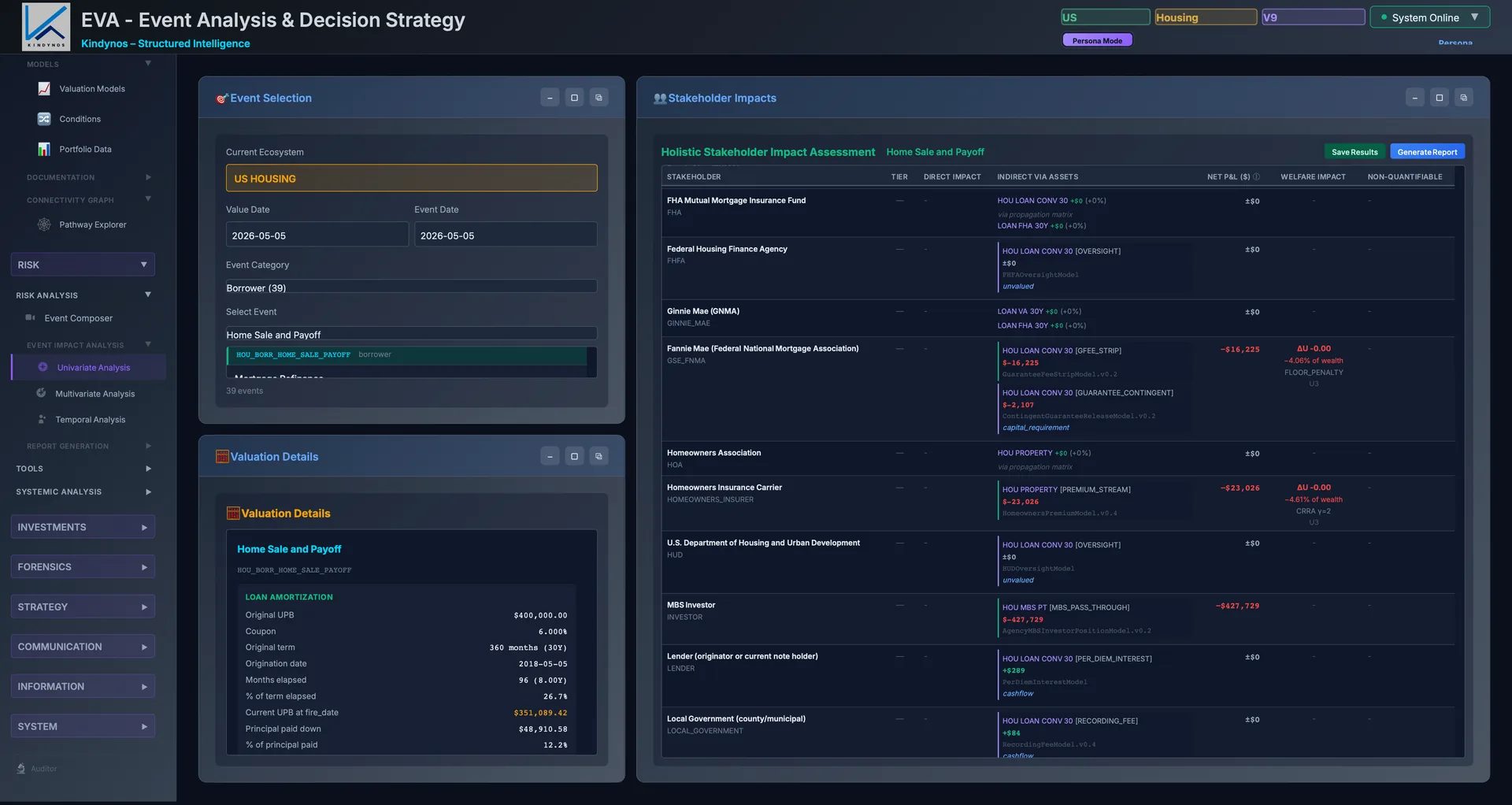
One selected event is carried through valuation details into stakeholder-specific financial consequences, preserving the model path and typed status for each row.
Open full capture ↗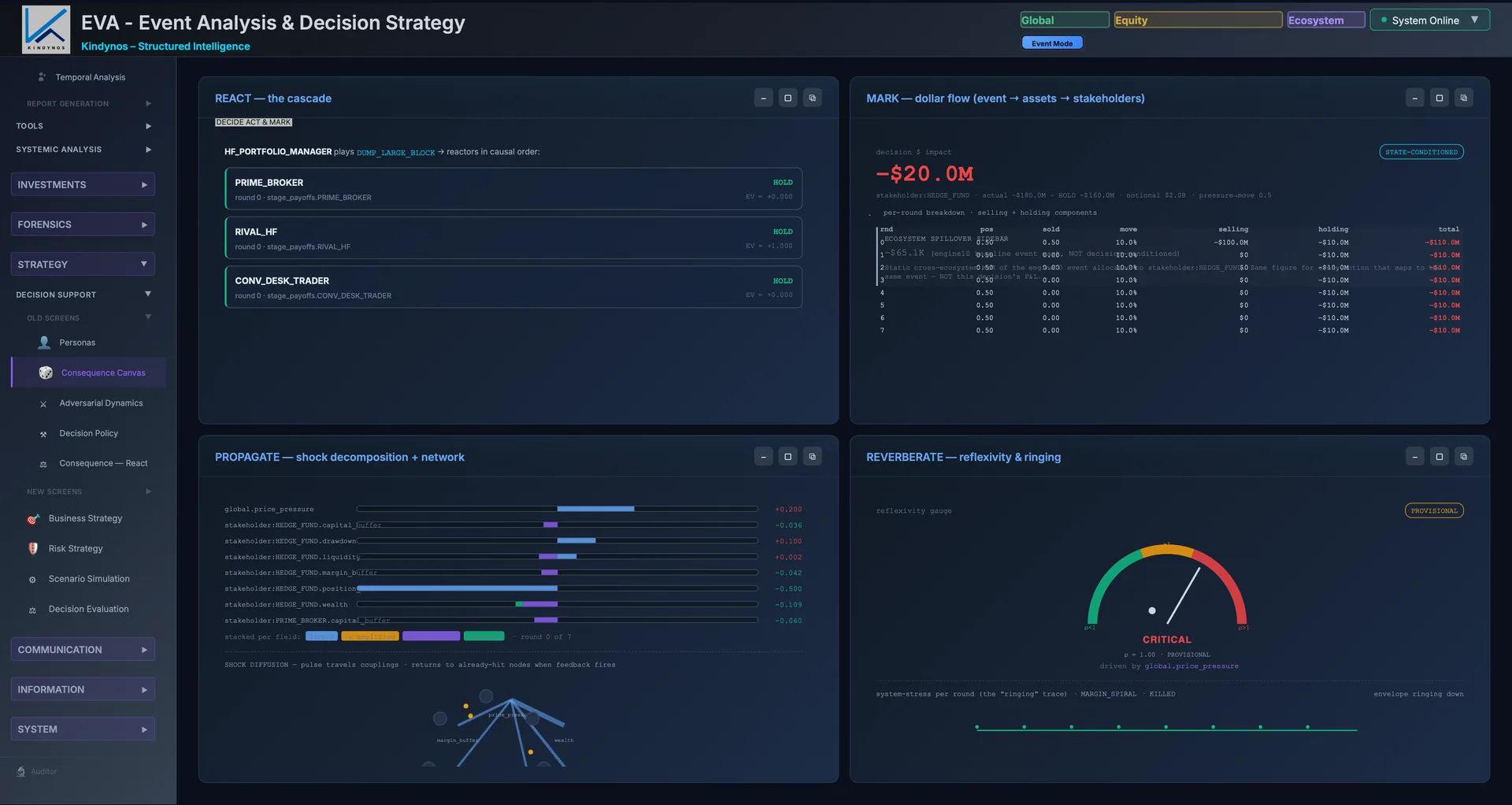
A decision path is shown through reactive actors, dollar consequences, state-conditioned propagation and a reflexivity view rather than as a single static score.
Open full capture ↗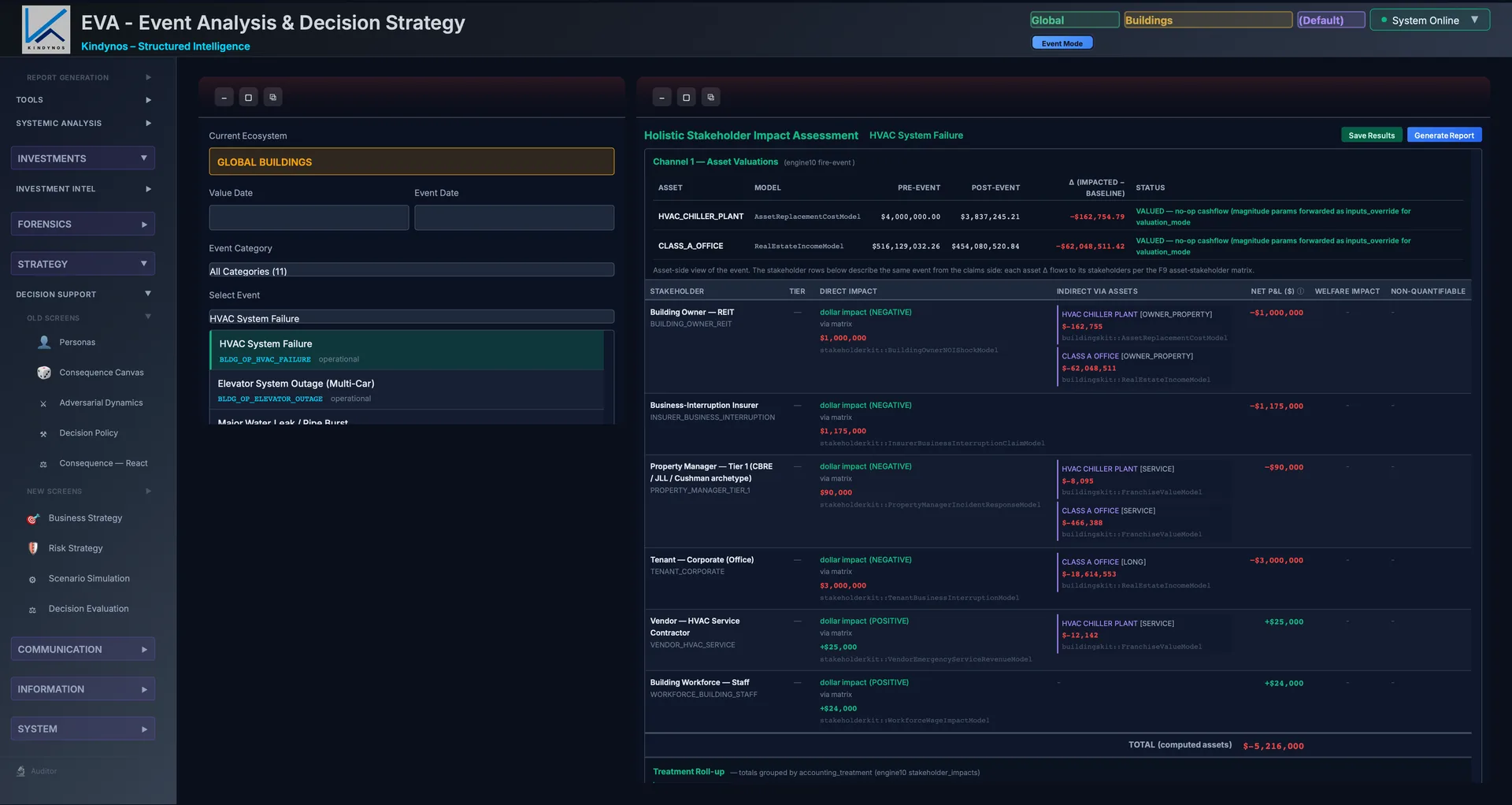
Asset revaluation and direct stakeholder channels appear together for the building owner, insurer, property manager, tenant, service vendor and workforce.
Open full capture ↗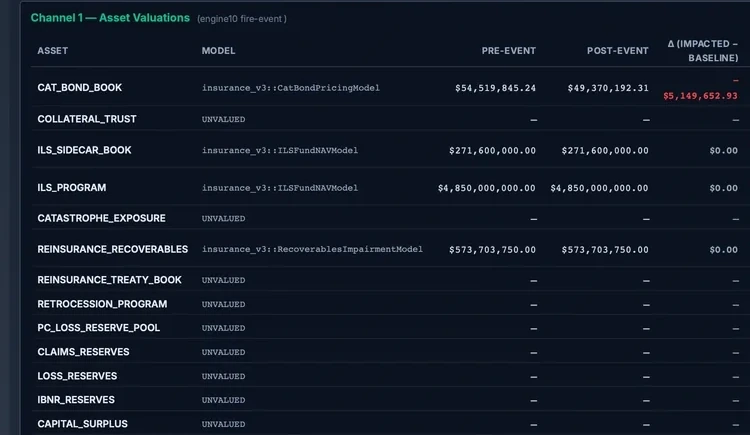
CAT_BOND_BOOK moves from approximately $54.52M to $49.37M. Other rows remain explicitly UNVALUED where no supported valuation is available.
Open full capture ↗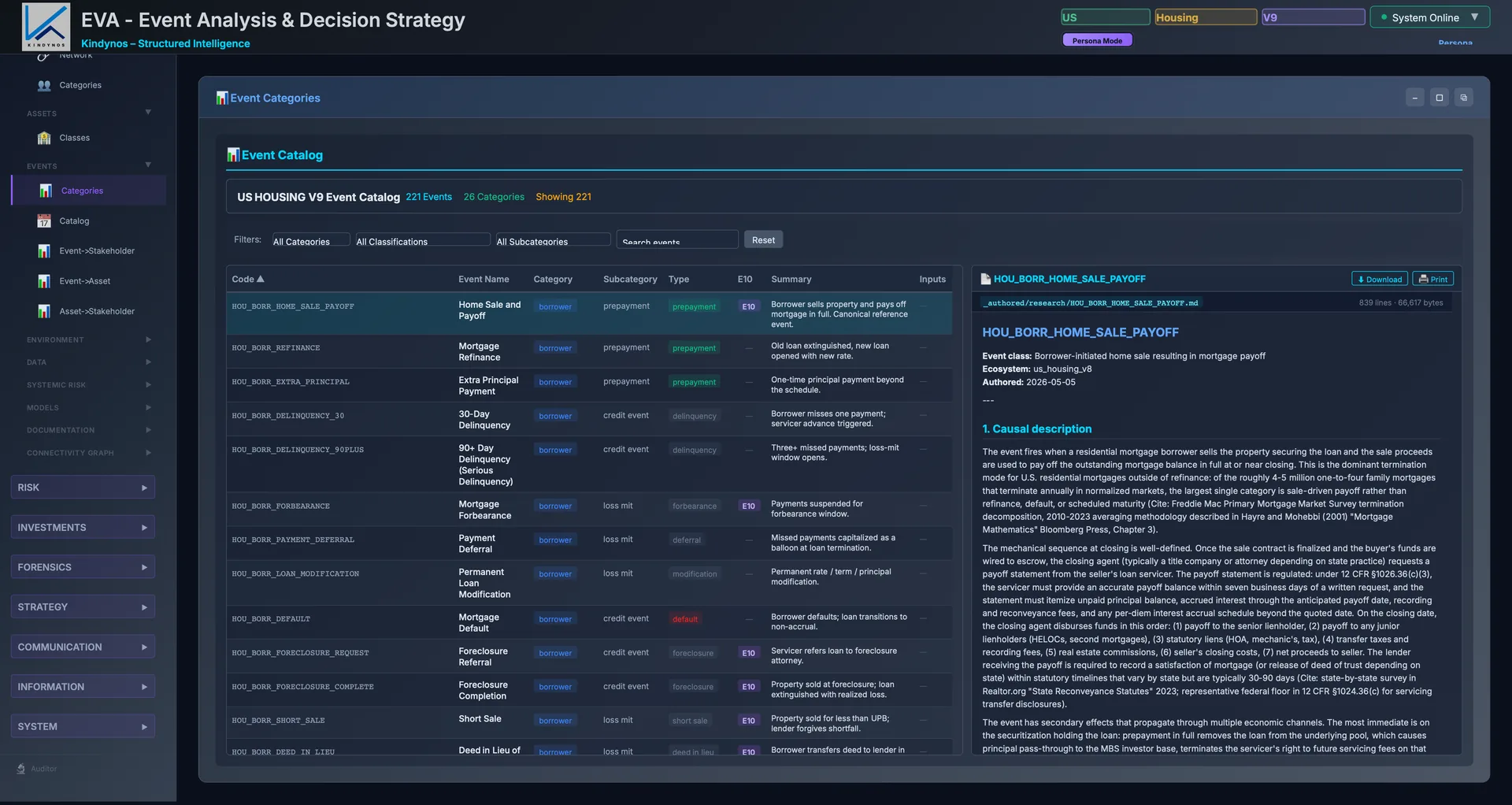
The captured world exposes 221 events across 26 categories; the selected Home Sale and Payoff event opens its authored causal description alongside the catalogue.
Open full capture ↗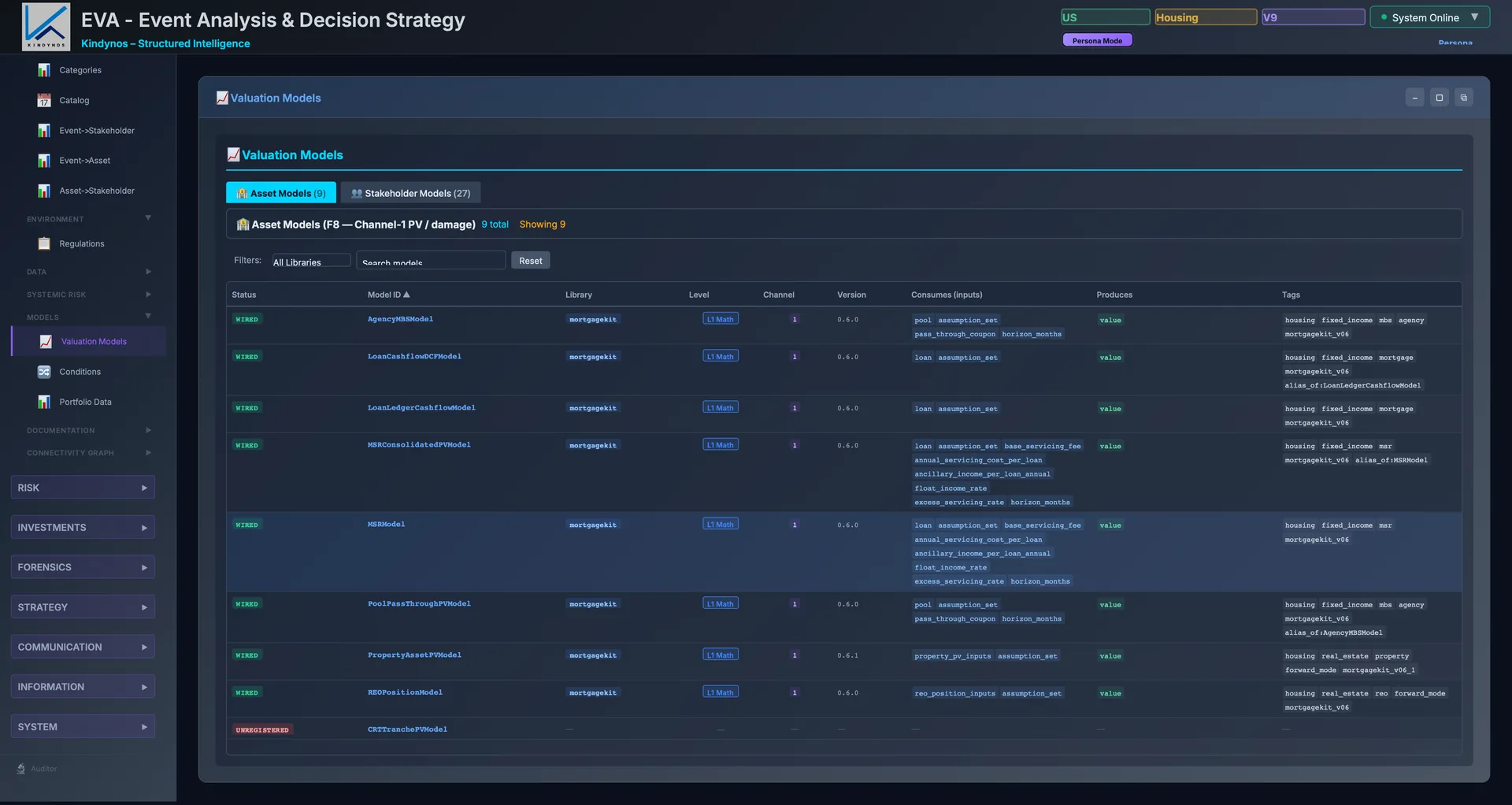
The valuation-model surface shows model identity, library, level, version, inputs and outputs—and visibly distinguishes WIRED coverage from an UNREGISTERED model.
Open full capture ↗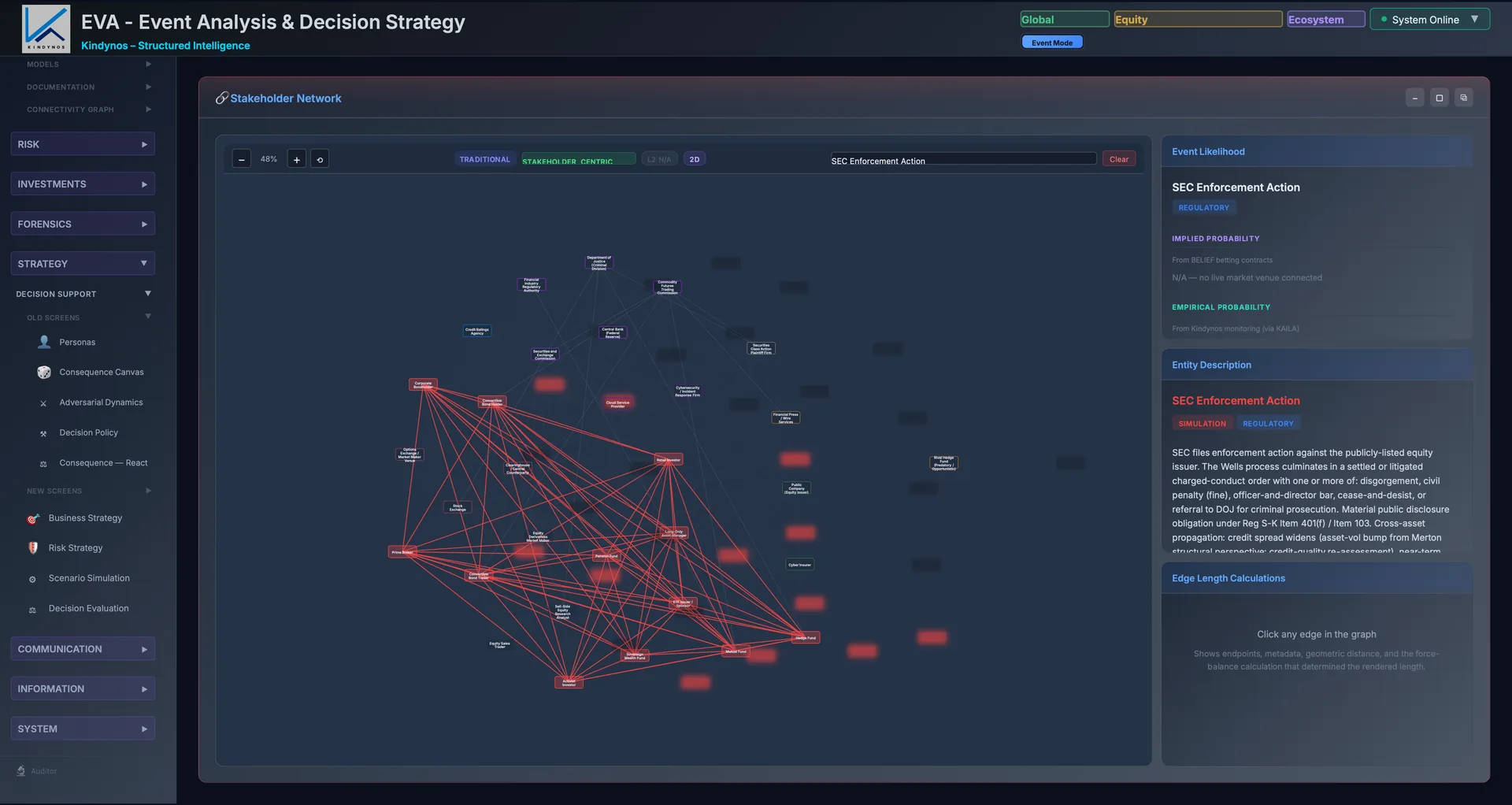
The SEC Enforcement Action is placed inside the equity-world relationship graph, with event description and affected network structure available in the same operator surface.
Open full capture ↗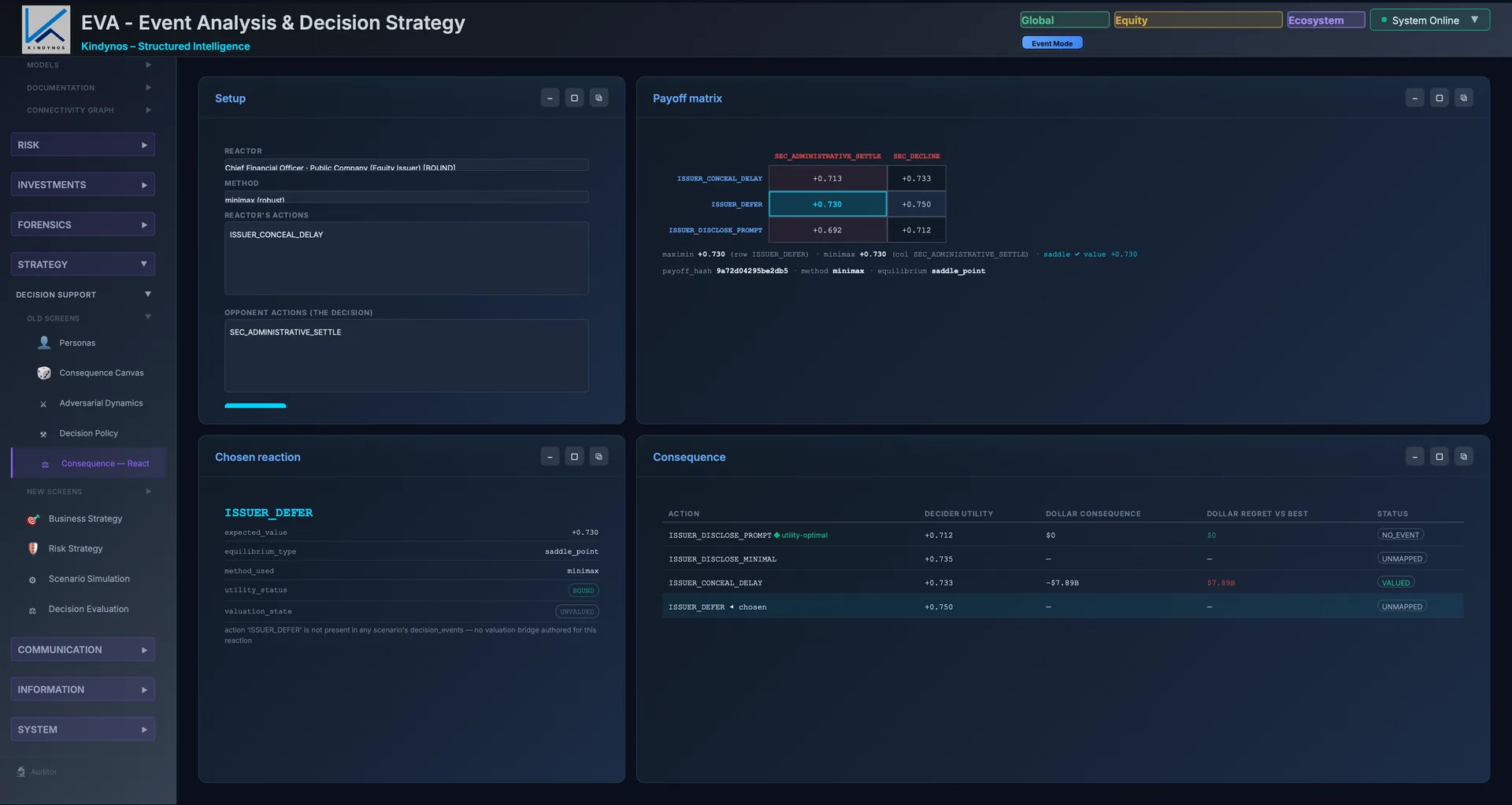
A minimax decision selects a reaction from the payoff matrix while the consequence panel separately shows which action outcomes are VALUED, NO_EVENT or UNMAPPED.
Open full capture ↗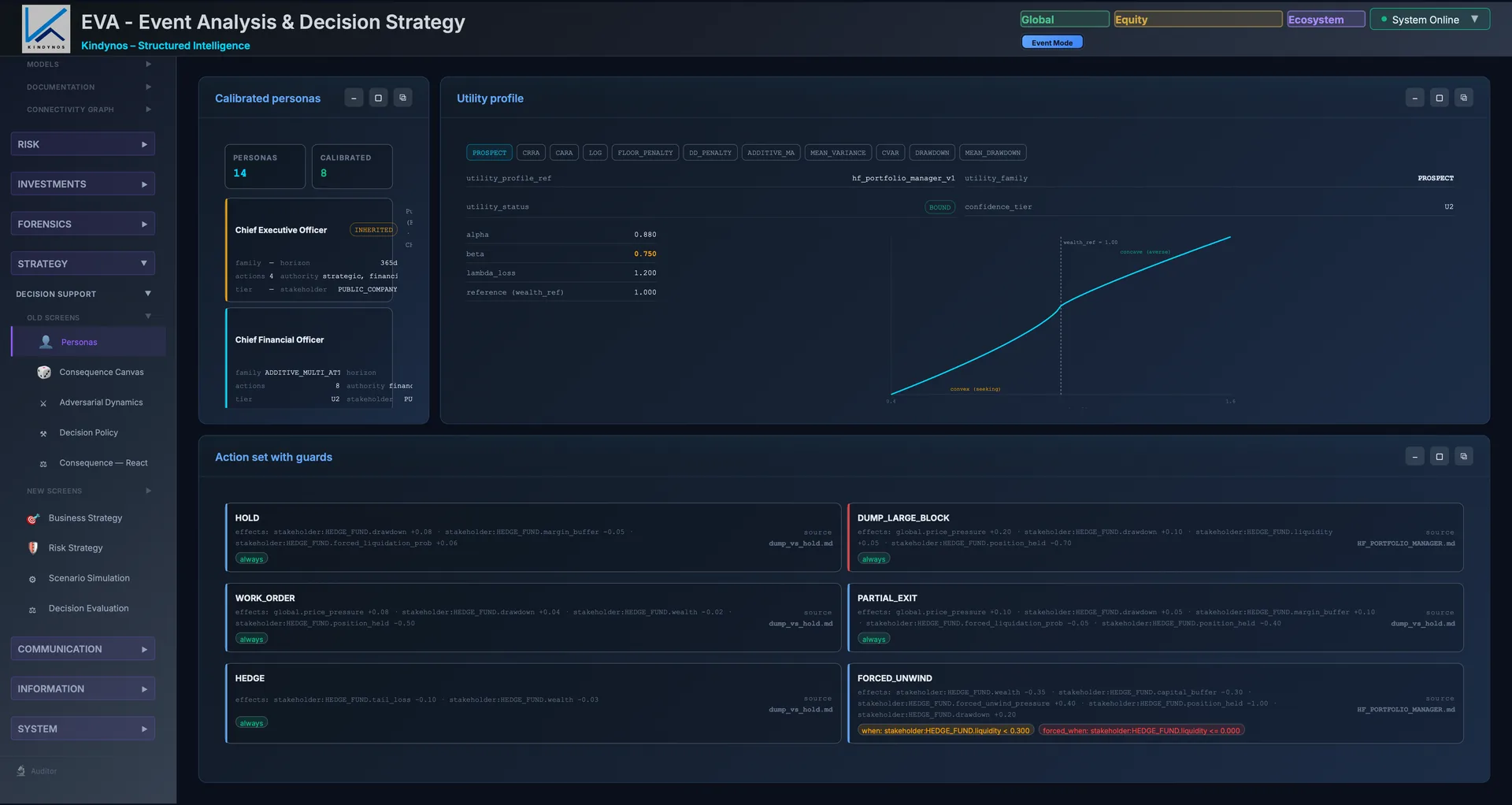
Persona calibration, a named utility family and guarded actions make the decision problem actor-specific rather than treating the institution as one homogeneous optimizer.
Open full capture ↗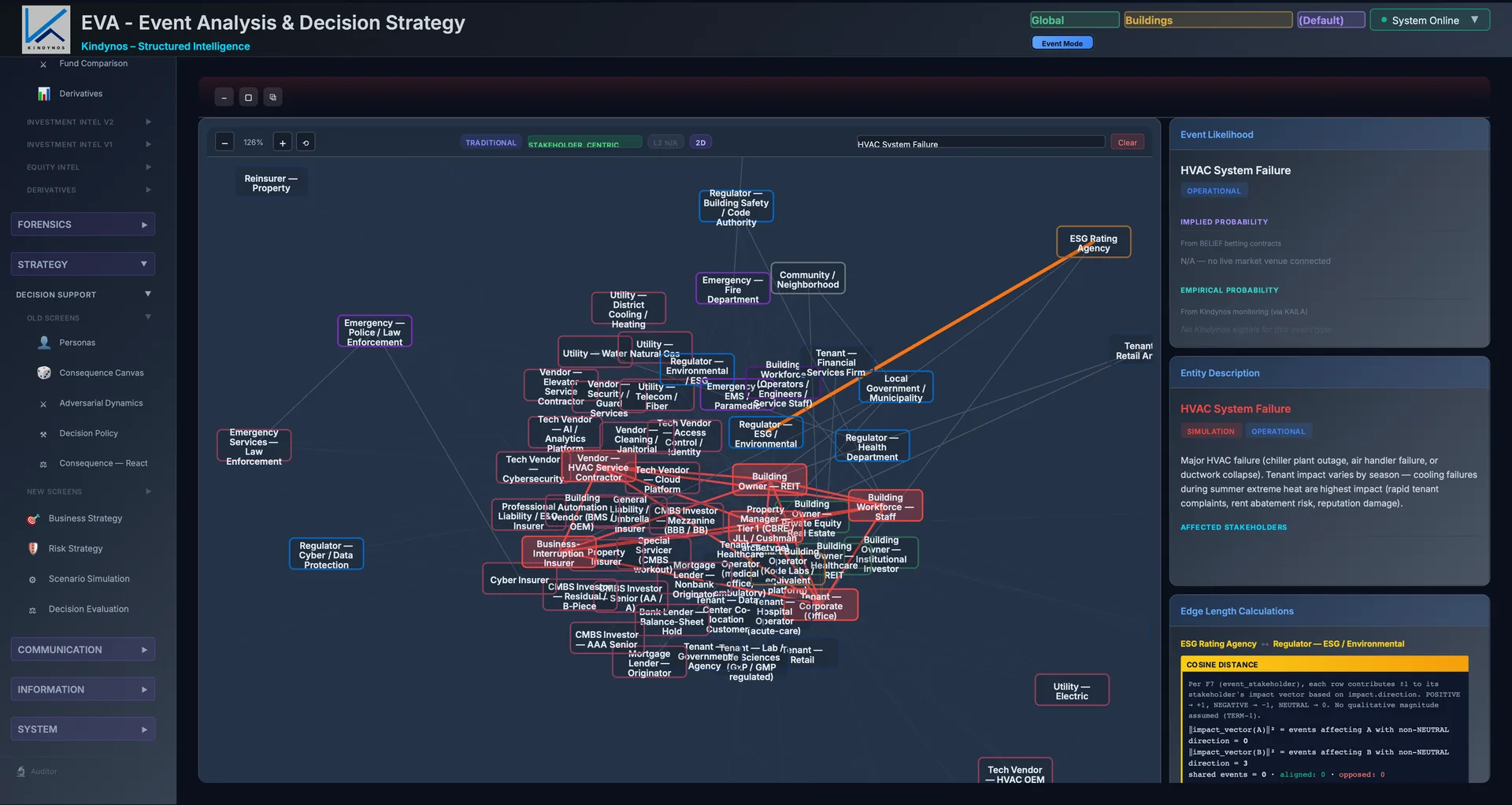
An HVAC system failure is located among owners, tenants, insurers, lenders, vendors, utilities, regulators and service providers before the impact analysis is run.
Open full capture ↗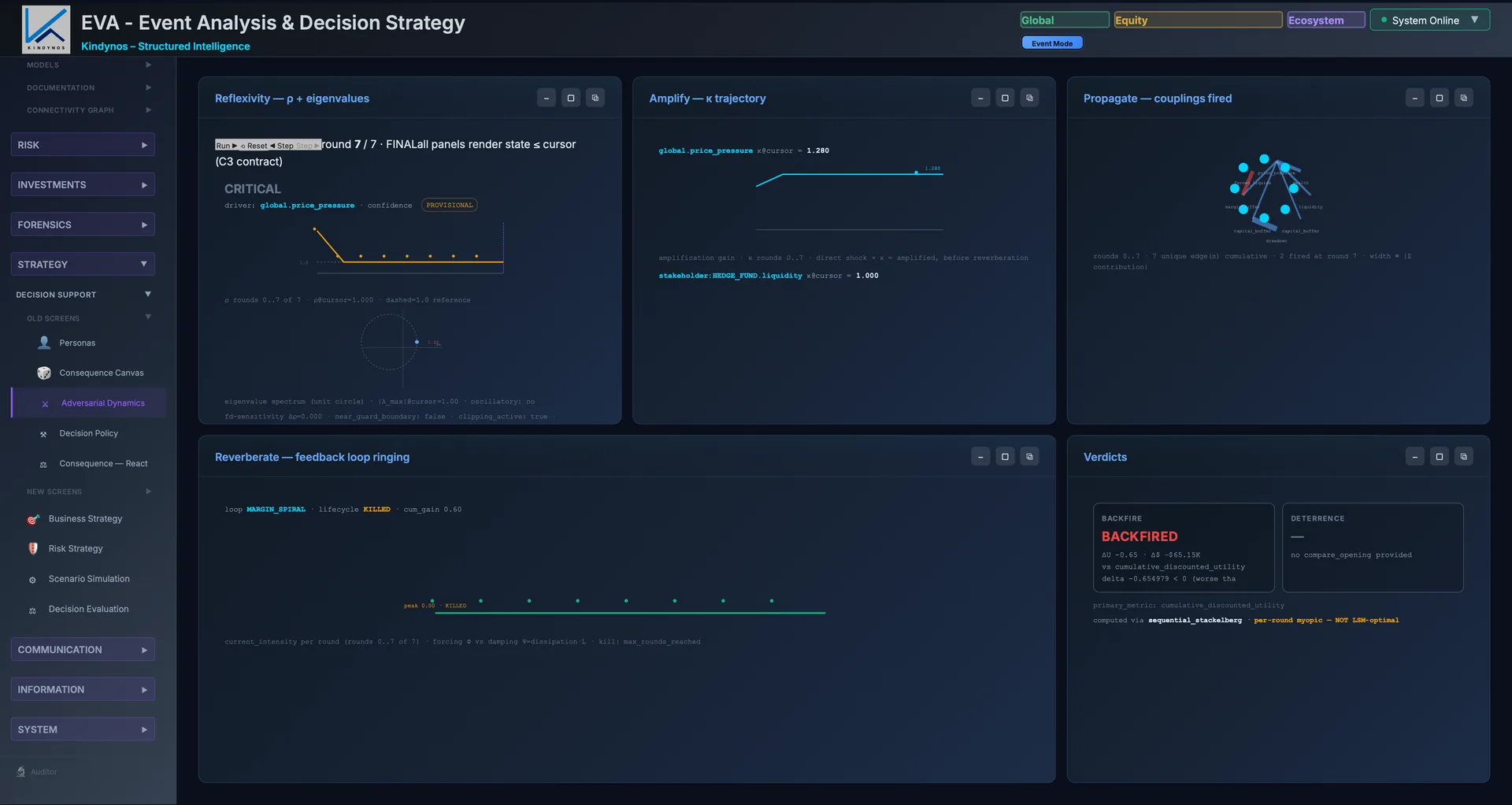
The interface exposes reflexivity, amplification, fired couplings and feedback-loop state, culminating here in a displayed BACKFIRED verdict for the selected path.
Open full capture ↗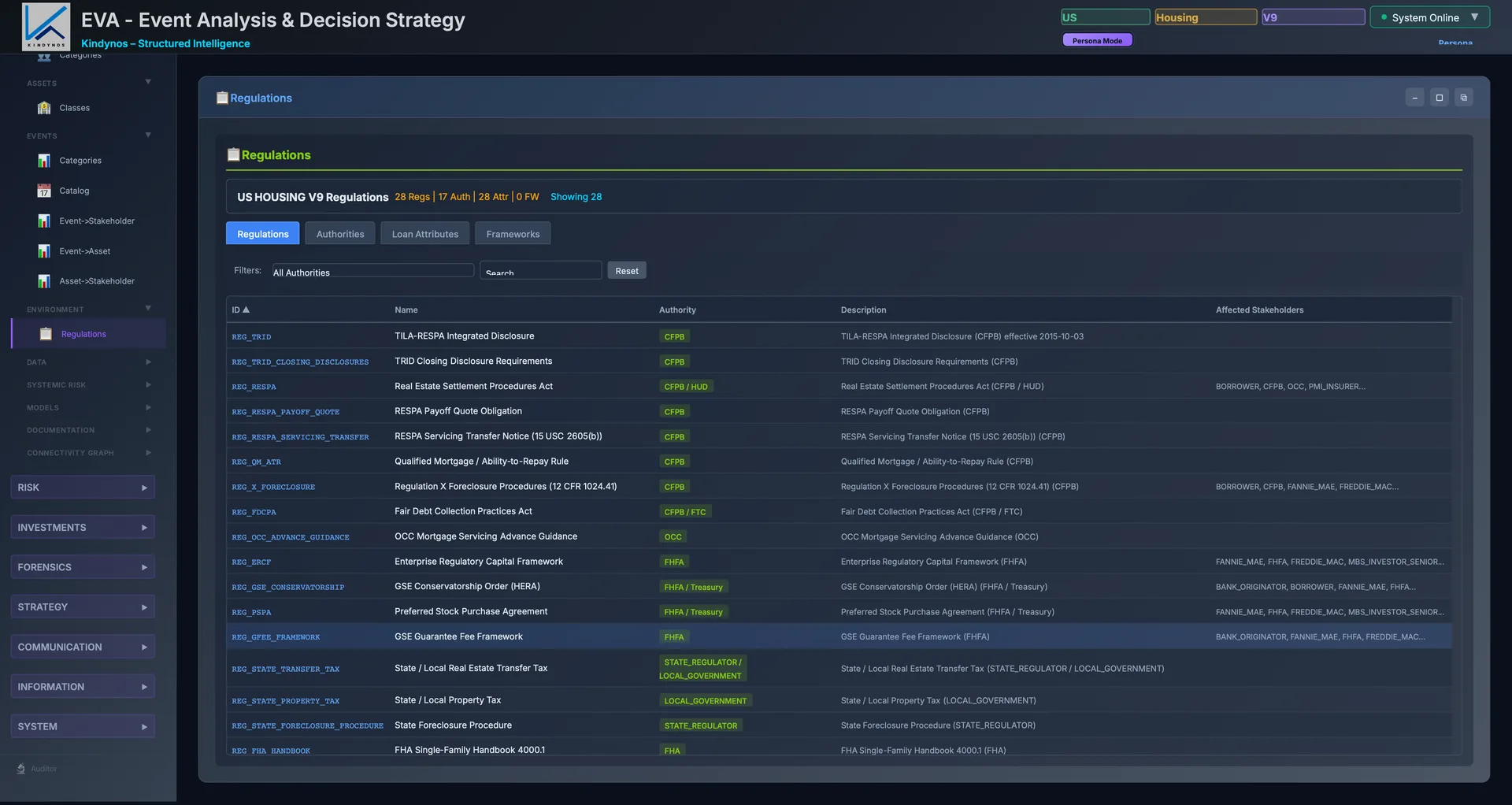
The captured registry exposes named authorities, regulations and affected stakeholders alongside the event and asset structures of the housing ecosystem.
Open full capture ↗Together these four cases demonstrate state transformation, optimization, multi-party allocation, cross-domain transfer and reproducible execution.
The forbearance path records servicing advances, capitalization and re-amortization before downstream loan, pass-through, IO, PO, MSR and guarantee-fee consequences. The technical record preserves the source freeze, model path and request/response identity.
The same authored fire-sale scenario is evaluated by two decision methods. The technical verification records the seed, path count, values, Monte-Carlo uncertainty, first-action disagreement and policy-gate status.
The path reconciles $120M retained plus three $130M ceded shares, records the retrocession treatment and ties the result to a named Insurance freeze.
The flood path carries physical damage and income loss into an insurance consequence. The $6.55M owner recovery and insurer payment reconcile exactly, with valuation status preserved for the remaining inputs.
The canonical request was executed directly and through a real MCP server subprocess. One thousand eight hundred and fifty-six fields were compared; not one differed.
Each public proof identifies the event, positions or stakeholders, key numbers and execution context. The four technical cases add deeper provenance.
Is this capability meaningful for this world, version and event path?
Do the registrations, routes, bindings and required models resolve—and has the path actually run?
Is there a named, reproducible result strong enough to support a public demonstration?
Explore the four verification paths for the execution layer, or bring a consequential event of your own and define the path that matters.