The represented world
- Policies, treaties, limits, deductibles and exclusions
- Insureds, carriers, reinsurers, brokers and investors
- Claims, reserves, capital and market capacity

Kindynos follows physical, cyber and catastrophe events into retained loss, claims, reinsurance, ILS, capital and stakeholder consequence—keeping the originating loss and the risk-transfer structure separate.
An event creates physical, operational or financial loss. Policy terms, attachment points, exclusions and risk-transfer structures determine how much stays with the insured, how much moves to the carrier, and how much moves again into reinsurance or the capital markets. Kindynos computes those consequences for the parties and positions that can be valued, while preserving explicit unresolved outcomes where required inputs are absent.
Kindynos incorporates authoritative actuarial and catastrophe outputs, then preserves how coverage, capital and response allocate the resulting consequences.
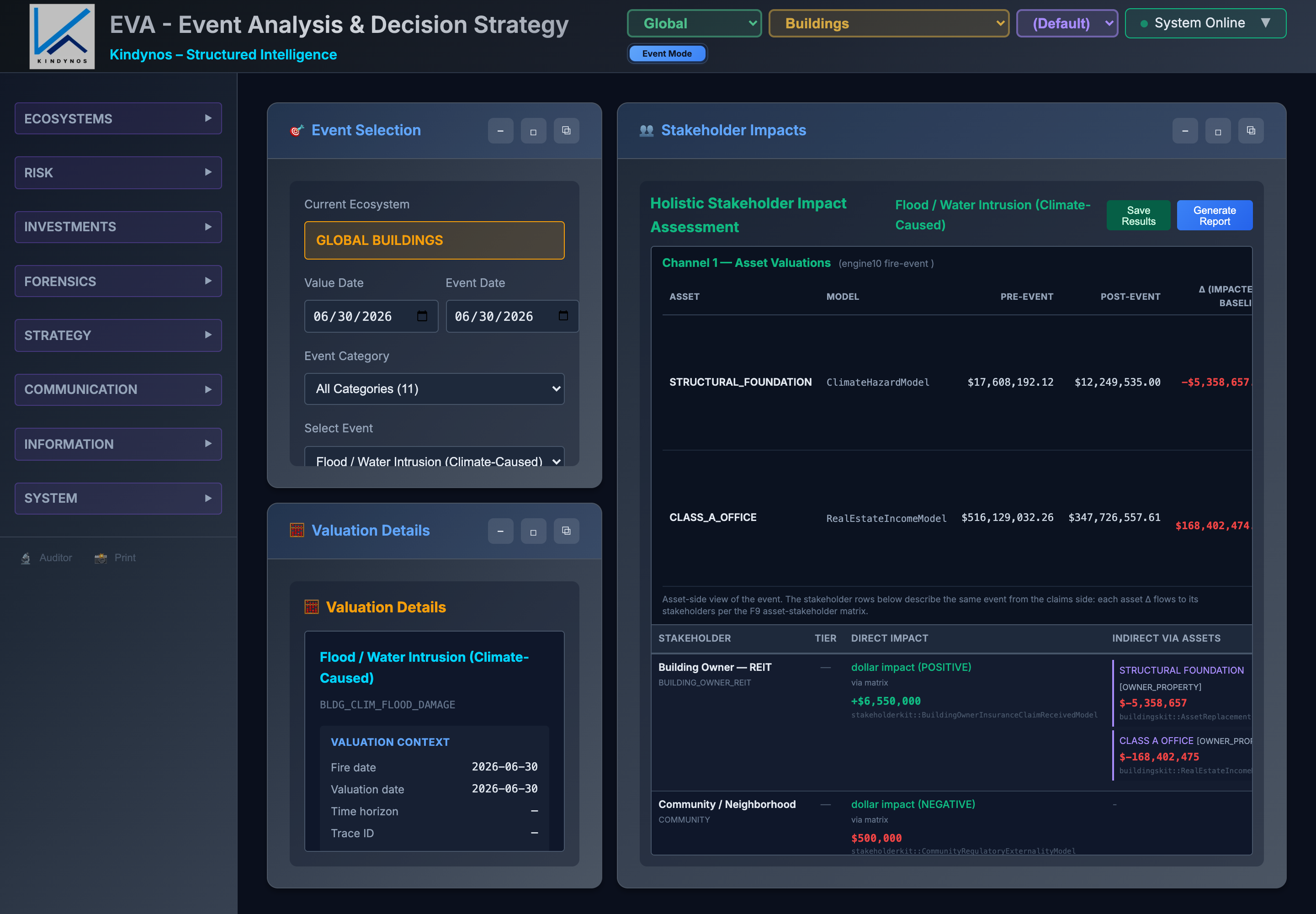
Consequence analysis brings together typed entities and objects, concrete state-changing events, explicit relationships and stakeholder-indexed outcomes.
Consequences can branch, create new events, and differ in sign and magnitude across stakeholders. Kindynos keeps those branches, relationships and unresolved outcomes visible.
The same firing keeps the physical and income loss visible while recording an exact business-interruption transfer between building owner and insurer.
Transfer pair = $0 exactly
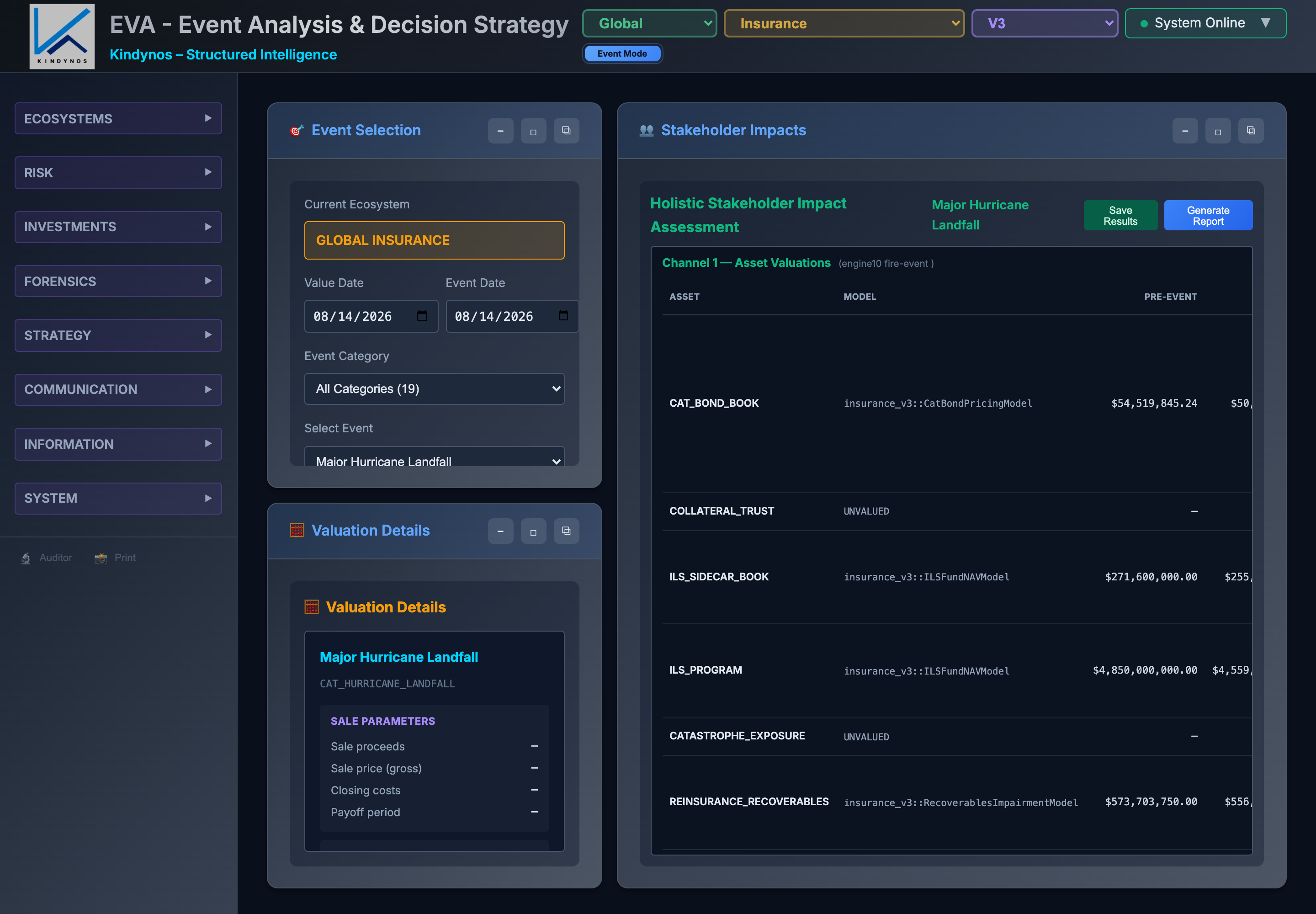
A $510M modeled insured loss is partitioned into insurer retention and three parallel reinsurance shares, while ILS assets, recoverables, policyholders and a public backstop remain separately represented.
Given declared cyber incident losses, retention, sublimits, per-claim limits and the aggregate policy determine what the insurer pays and what the insured retains.
Scenario-level policy valuation: the incident amounts are declared inputs to the policy waterfall.
Review the evidence frame →The Insurance model family keeps the deterministic reference separate from real seeded stochastic cat-bond models. A restored stochastic path nearly reproduces the authored attachment/exhaustion probabilities and agrees with an independent implementation under a common calibration.
Kindynos has developed a multi-stakeholder Global Insurance ecosystem with verified reference paths across catastrophe, cyber, Buildings-linked transfer and insurance-linked securities.
Use a bounded exposure set, policy/treaty structure and a historical outcome. The bounded engagement reconstructs the chain from event through coverage and accumulation to the parties who ultimately bear the loss, then tests one alternative response.