Identity & state
Typed assets and entities, stakeholders, relationships, obligations, time and state transitions.

The technology layer defines how represented state is changed, how models are resolved and executed, how results are recorded, and how users or other systems access the analytical services.
A useful answer depends on explicit state, explicit model resolution and a reviewable path from inputs to consequence.
Events, observations, data and proposed actions.
Assets, stakeholders, relationships, obligations and state.
Apply the event or intervention to the represented ecosystem state.
Select supported models and compute consequence.
Preserve result, provenance, assumptions and refusal states.
The substrate keeps identity, ecosystem state, model binding, execution status and provenance explicit so every analytical surface refers back to the same governed state.
Typed assets and entities, stakeholders, relationships, obligations, time and state transitions.
Named model identities, applicable inputs, versioned execution and explicit coverage status.
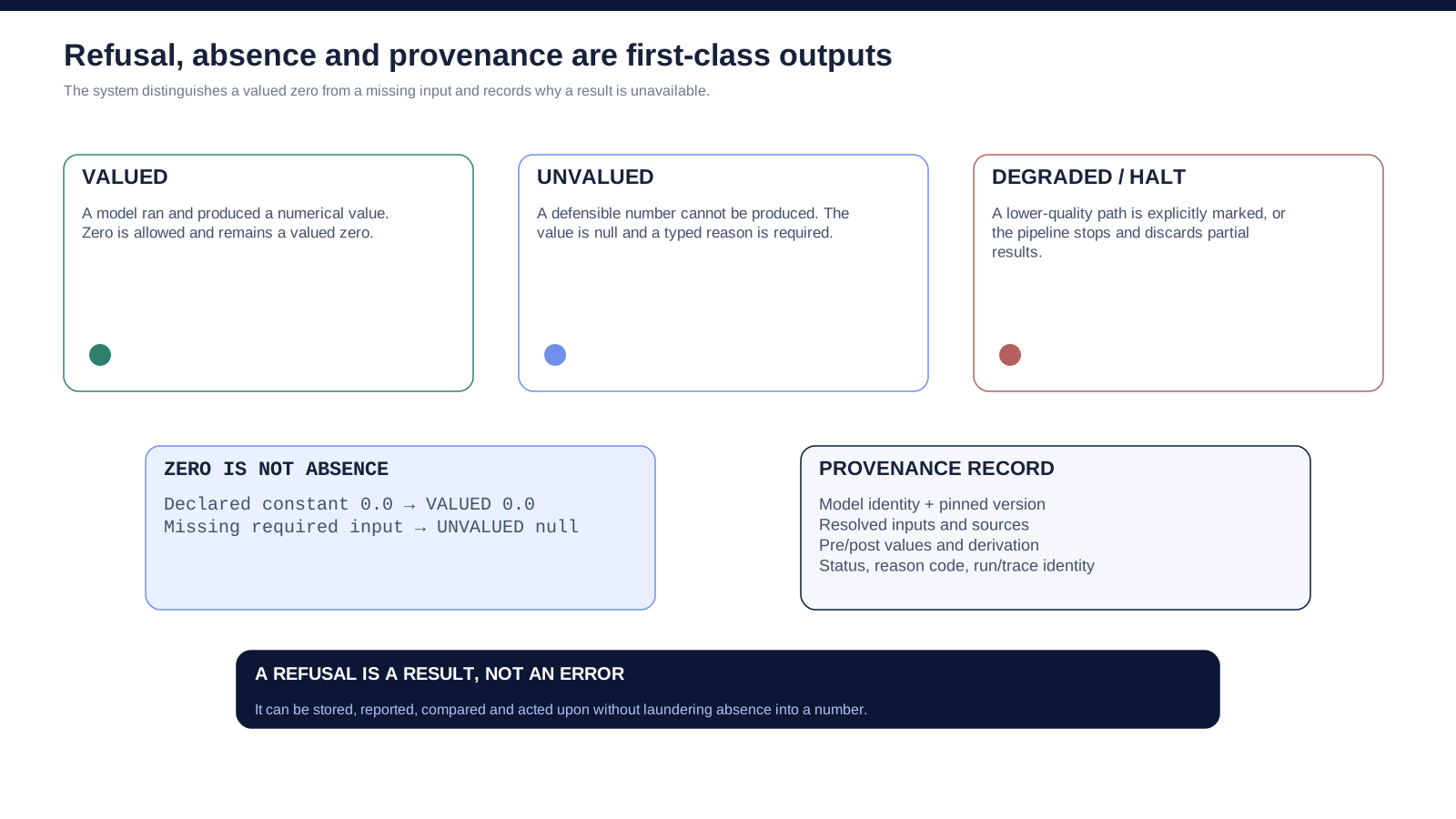
Valued, not applicable, unresolved inputs and unvalued outcomes remain distinguishable, and a genuine zero is not the same as an absence.
Inputs, assumptions, model lineage and evidence artifacts are attached to asset valuation results, so a figure can be traced to the model and inputs that produced it.
Declared reproducibility and invariance requirements appropriate to the evaluator, including controlled seeds or deterministic execution where required.
Only supported calculations can become authoritative state.
EOS and EPL provide a modular direction for describing events, state transitions, model bindings and execution semantics beneath analytical applications.
The architecture separates represented state and governed execution from any single user interface.
The four Core Systems have different roles, but the technology beneath them keeps state, models, evidence, execution and access contracts explicit. This is where implementation architecture belongs; it is deliberately separated from the Core Systems page.
Web tools, APIs, MCP and connectors expose Kindynos capabilities without performing their own calculation. Access mechanisms reach governed analytical services while numerical authority remains in those services.
Interactive analytical surfaces for events, state, evidence, valuation and decisions.
Programmatic access to governed analytical services and results.
A bounded tool surface an external client can reach over the Model Context Protocol. The client issues a request; EVA performs the analysis and returns it inside a governance envelope.
See the verified MCP demonstrationExternal data, intelligence and specialist models can enter through governed interfaces with provenance preserved.
An evaluator may be an explicit financial model, a numerical service, a specialist external tool or a controlled composition of them. The architecture keeps ecosystem state, permitted dependencies, evidence, invariants, provenance and refusal conditions explicit around whichever evaluator is appropriate.
A language model is not an evaluator. It can help a user reach one — in conversation, or through a protocol — but it computes nothing on the way. The request is carried; the value is not.