Fines are small. The refund is not.
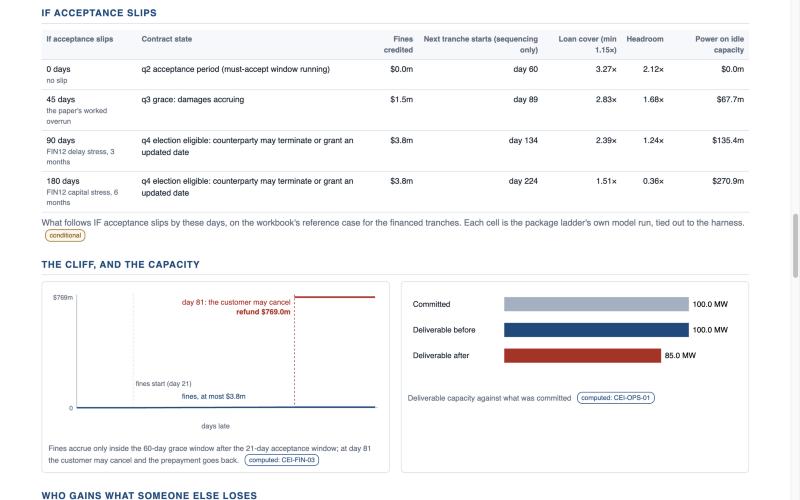
A late tranche pays fines, capped at $3.8m. If it is late enough, the customer may cancel and the prepayment goes back: about $769m. The ratio is about two hundred to one.

One occurrence, followed end to end through EVA: the seconds in which it is noticed, the days and dollars it puts at stake, the number each executive receives, what management can still do, and what the market will eventually see. Every figure on this page is an EVA model run, and the screens are EVA's own.
This is the chain EVA computes. Each step is ordinary on its own; together they connect a pump to a refund, a covenant and the share price.
A late tranche pays fines, capped at $3.8m. If it is late enough, the customer may cancel and the prepayment goes back: about $769m. The ratio is about two hundred to one.
Contracted power is paid for capacity that is not yet earning. Each 45 days of delay adds about $68m of power paid for idle capacity.
Cash cover on the secured loan is 3.27 times debt service against a 1.15 times covenant. Late acceptance is what wears it down.
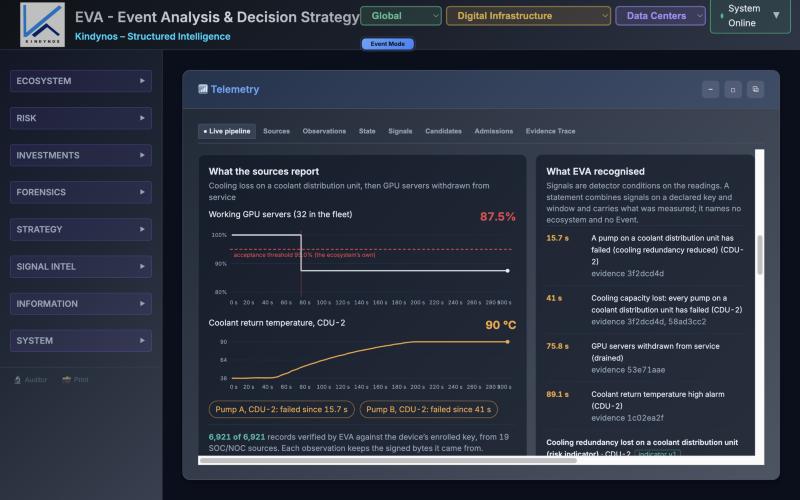
The emulated data hall: 32 GPU servers cooled by two coolant distribution units, watched by 19 operations sources including the building management system, a camera and a microphone. Every record is signed at the source and verified by EVA. The run below was recorded on 27 October 2026.
| Time | What the sources reported | What EVA did |
|---|---|---|
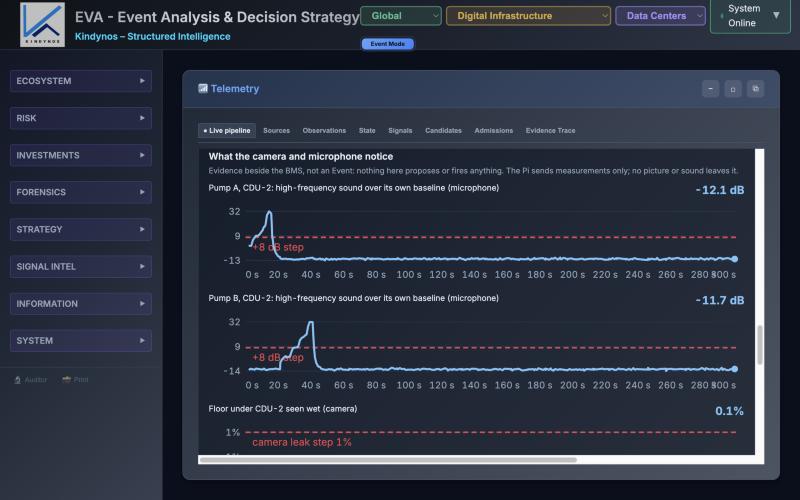
| 5.7 s | The microphone hears pump A on CDU-2 running abnormally: +32 dB over its own baseline. The building system still reports the pump as running. | Early warning, pointing at the cooling Event, 10 seconds before the building system reported the failure. |
| 15.7 s | The building system reports pump A failed. | Statement: cooling redundancy lost on CDU-2. |
| 41 s | Pump B fails. CDU-2 has no pump running; it cools 16 of the 32 servers. | Event proposed: Cooling capacity derate on a coolant distribution unit, measured derate 50%. Confirmed by a named person. |
| 75.8 s | Four servers withdrawn from service: 87.5% of the fleet working, below the 95% acceptance threshold. | Second Event proposed: Fleet health below the acceptance threshold. Confirmed. |
| 89.1 s | Coolant return temperature high alarm on CDU-2. | Corroborates the cooling statement. |
All 6,921 records in the run were verified against the device's enrolled key. The camera and microphone add evidence beside the building system but never fire anything themselves, and no picture or sound leaves the device: it sends measurements only.
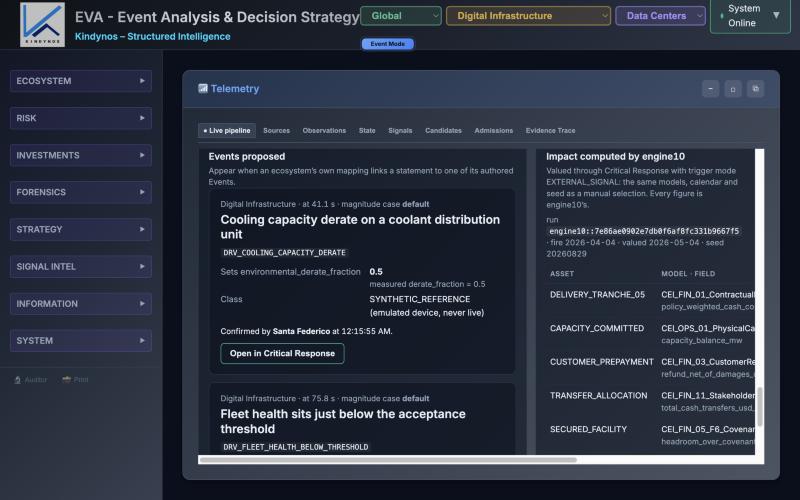
This is the step no alarm panel takes. EVA's briefing runs the occurrence through the contract, cash, financing and securities models. It is valued at the Event's authored magnitudes (a 15% derate, acceptance 45 days late), so it can be read from the early warning, before the Event has happened.
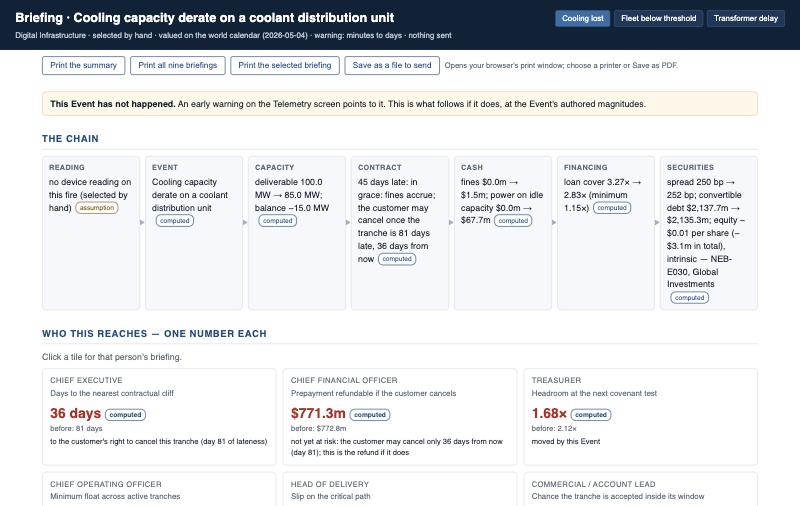
15 MW short of what was committed
in grace: fines accrue; acceptance still mandatory for now
paid for capacity earning nothing
cash cover on the secured loan (minimum 1.15×); headroom 2.12× → 1.68×
Fines accrue only inside the 60-day grace window after the 21-day acceptance window. At day 81 the exposure jumps from a few million dollars of fines to the prepayment.
The briefing computes what follows if acceptance slips further. Each row is a model run on the reference case for the financed tranches, conditional and not weighted by any probability.
| If acceptance slips | Contract state | Fines | Next tranche starts | Loan cover (min 1.15×) | Headroom | Power on idle capacity |
|---|---|---|---|---|---|---|
| 0 days | acceptance window running | $0.0m | day 60 | 3.27× | 2.12× | $0.0m |
| 45 days | grace: damages accruing | $1.5m | day 89 | 2.83× | 1.68× | $67.7m |
| 90 days | the customer may terminate or grant an updated date | $3.8m | day 134 | 2.39× | 1.24× | $135.4m |
| 180 days | the customer may terminate or grant an updated date | $3.8m | day 224 | 1.51× | 0.36× | $270.9m |
EVA briefing for the cooling Event, valued on the ecosystem's own calendar.
They cap at $3.8m. The power bill on idle capacity keeps growing, roughly $68m for every 45 days.
Headroom at the next test falls from 2.12 to 0.36 times as the delay runs to six months.
At day 81 the exposure jumps from a few million dollars of fines to a $769m refund.
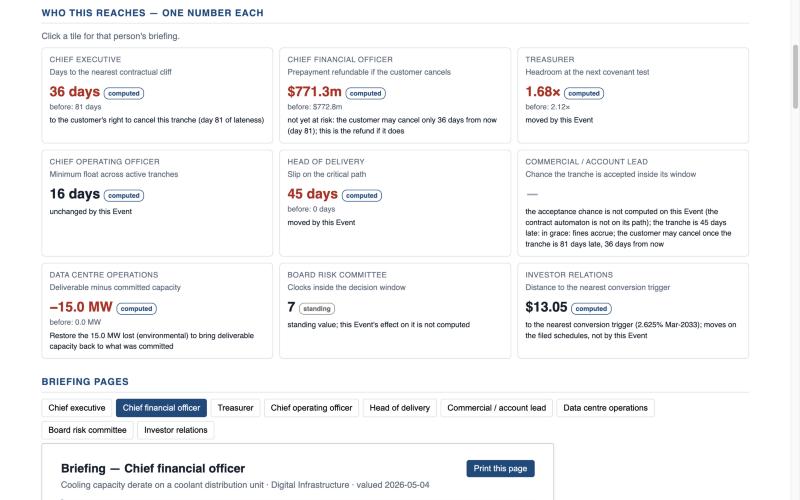
The same run produces the number that matters to each decision, what it was before, and whether this Event moved it.
| Who | The one number | Before → after | What it tells them |
|---|---|---|---|
| Chief executive | Days to the nearest contractual cliff | 81 → 36 days | How long before the customer may cancel |
| Chief financial officer | Prepayment refundable if the customer cancels | $772.8m → $771.3m | What is at stake; not yet at risk for 36 days |
| Treasurer | Headroom at the next covenant test | 2.12× → 1.68× | How much of the covenant cushion this uses |
| Chief operating officer | Minimum float across active tranches | 16 days, unchanged | Whether other tranches are now exposed |
| Head of delivery | Slip on the critical path | 0 → 45 days | The delay to plan around |
| Data-centre operations | Deliverable minus committed capacity | 0 → −15.0 MW | What has to be restored |
| Board risk committee | Clocks inside the decision window | 7, standing | How many contractual clocks are running |
| Investor relations | Distance to the nearest convertible trigger | $13.05 | How close the share price is to a trigger |
The commercial lead's number, the chance the tranche is accepted inside its window, is shown as not computed on this Event, because the model that computes it is not on this Event's path. EVA says so rather than filling it in.
In the investor's ecosystem, the cooling failure is an Event on the company's analyst model. Its mapping record carries the occurrence into that model: the first two tranches accepted 45 days late, the operator view's own delay, with damages inside the grace period. The credit model reads the same delay.
| Instrument | Before | After | Change | Computed by |
|---|---|---|---|---|
| Common equity, intrinsic value per share | $235.37 | $235.36 | −$0.01 | the analyst's own model, converted cell by cell |
| Common equity, total | $86,340.2m | $86,337.1m | −$3.1m | the analyst's own model |
| Secured facility, value | $781.2m | $780.6m | −$0.6m | bond pricing (QuantLib) |
| Secured facility, credit spread | 250 bp | 252 bp | +2.3 bp | credit model on the analyst model's own credit metrics |
| Convertible note, debt component | $2,137.7m | $2,135.3m | −$2.4m | bond pricing (QuantLib) |
| Common equity, total, if acceptance slips 91 days and the customer terminates the first tranche (conditional) | $86,332.0m | $86,059.2m | −$272.8m | the analyst's own model |
Valued at the investor ecosystem's declared valuation date. The conditional row is not weighted by any probability, and the redeployment value of the freed capacity is not counted. The convertible's option value is not valued on this Event, and EVA says why. The credit model's coefficients are a synthetic reference calibration, stated as such on screen.
A 45-day delay costs the shareholders almost nothing on paper. The same occurrence, if it is allowed to reach the cancellation right, costs them $272.8m, and the operator's view shows exactly how many days are left to prevent it.
EVA does not choose for management. It answers six questions in the order an executive needs them, and puts a number on each lever while it is still inexpensive.
The signed readings, the statements they support, how many sources corroborate them, and who confirmed the Event.
Not "a delay" but a state: inside the acceptance window, in grace with fines accruing, or past the point where the customer may terminate.
The days to the nearest cliff. This is the number that sets the agenda.
The slip table, as conditional model runs, not a probability-weighted average that hides the cliff.
Operations restores the capacity; the treasurer watches headroom before the next test; the CFO owns the revenue and power consequences.
The investor's view of the same occurrence: the shares, the bonds and the spread.
| Lever | Owner | Window | The EVA number that tells you whether it worked |
|---|---|---|---|
| Restore the 15 MW before acceptance testing | Data-centre operations | Before the tranche is tested | Deliverable minus committed capacity back to 0 MW |
| Open the conversation about an updated acceptance date | Chief executive and commercial lead | Before day 81, while the customer has no right to cancel | Days to the nearest cliff |
| Size the covenant risk and brief the lenders early | Treasurer | Before the next covenant test | Headroom at the next test, on the 90- and 180-day rows |
| Re-plan the next tranches | Head of delivery, COO | Now | Next tranche start; minimum float across tranches |
| Prepare what the market will see | Investor relations | Before results | Equity and spread in the investor's view; distance to the convertible triggers |
Levers that are themselves Events in the ecosystem, such as "the customer grants an updated delivery or acceptance date", can be run the same way, so the effect of an option is a model run too, not an opinion.
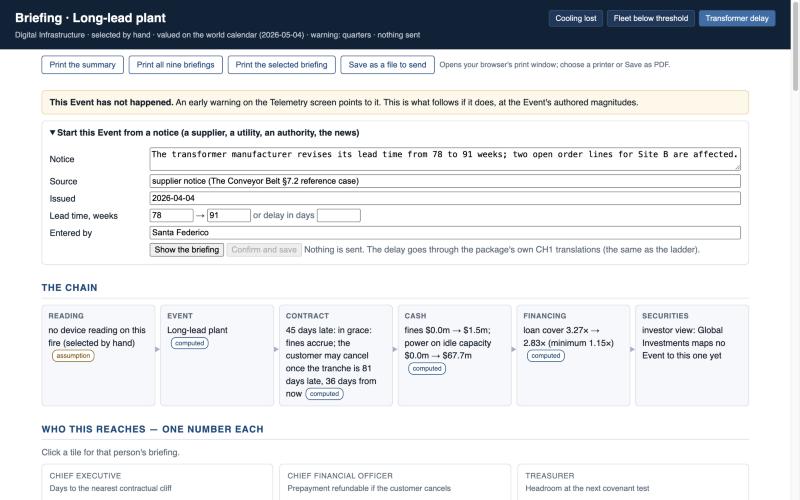
A transformer manufacturer revises its lead time from 78 to 91 weeks, affecting two order lines for one site. The notice is entered, the briefing is shown, and the same chain follows: 45 days late, fines, idle power, loan cover. Nothing is saved until a person confirms it, and nothing is sent.
The EVA engine; the telemetry pipeline with records signed and verified; the briefing; the analyst's model converted cell by cell; the bond and curve pricing; the filed conversion schedules of the convertible notes.
The data hall is emulated on a small device and classed as a synthetic reference, never live. Event magnitudes, and the contract terms the filings redact, are illustrative values.
The convertible notes' option value (their debt component is valued). The credit model's coefficients are a synthetic reference calibration. Each is stated on the screen where it applies.
Describe what has happened, or what may happen. Kindynos will say what can be computed, what evidence it needs and which decisions the result can inform.