Kindynos EVA

When something happens, what does it actually mean for your business?

A pump fails on a cooling unit. An engineer sees an alarm. The chief executive needs something else: how many days remain before the largest customer may cancel, and how much money goes back if it does. Kindynos EVA follows the occurrence through your contracts, financing and valuation models, and tells each executive, in seconds, the one number that matters to them.

A cooling failure, as each executive receives it
Chief executive
36 daysuntil the customer may cancel the tranche (was 81)
Chief financial officer
$771.3mof prepayment refundable if it does
Treasurer
2.12× → 1.68×headroom at the next covenant test
Operations
15 MWto restore to deliver what was committed

Worked example: a GPU-cloud operator modelled from its public filings; emulated data hall; contract terms the filings redact use labelled illustrative values. Every figure is an EVA model run.

The gap

Every company runs on two languages.

The place where things happen speaks in decibels, temperatures and supplier notices. The boardroom speaks in contract rights, covenant headroom and share value. Almost nothing translates between them, quickly or reliably.

What an executive usually receives

A risk register

Cooling failureAMBER
Delivery delayRED
Covenant pressureAMBER

Three lines, owned by three teams, with no link between them: no amount, no date, and nothing on what to do first. By the time the number reaches the CFO, the inexpensive options have often expired.

What EVA gives instead, for the same pump failure
  • Chief executive: 36 days to the customer's right to cancel
  • Chief financial officer: $771.3m of prepayment refundable if it does
  • Treasurer: covenant headroom from 2.12× to 1.68×
  • Head of delivery: 45 days on the critical path
  • Operations: 15 MW to restore
  • Investor relations: $13.05 between the share price and the nearest convertible trigger

One chain, one run. Every number can be traced to the model or the filing that produced it.

One worked example

From a pump on the data-hall floor to the bottom line.

First the seconds, measured on an emulated data hall: 32 GPU servers, two cooling units, 19 operations sources, every record signed and verified. Then the days and dollars, from EVA's briefing.

5.7 s
The microphone hears pump A on cooling unit CDU-2 running abnormally.

The building management system still reports the pump as running. EVA raises an early warning, with its distance to the Event it points to.

15.7 s
The building system reports pump A failed: cooling redundancy lost.

The microphone had noticed it 10 seconds earlier.

41 s
Pump B fails. CDU-2 has no pump running; it cools 16 of the 32 servers.

EVA proposes the Event "Cooling capacity derate on a coolant distribution unit". A named person confirms it before anything is computed.

75.8 s
Four servers are withdrawn: 87.5% of the fleet is working, below the 95% acceptance threshold.

6,921 of 6,921 records were verified against the device's enrolled key.

What it means for the business
Capacity100 MW → 85 MW

15 MW short of what was committed

ContractHanded over 45 days late

inside the grace period: fines accrue

Cash$1.5m fines, $67.7m power

paid for capacity earning nothing

FinancingLoan cover 3.27× → 2.83×

against a covenant minimum of 1.15×

The cliff36 days until the customer may cancel the tranche, and $769m of prepayment goes back.

The fines are capped at $3.8m. The refund is about two hundred times larger: the contract turns on acceptance, not on fines.

The seconds are from a recorded run of the emulator. The days and dollars are EVA's briefing for the same Event at its authored magnitudes (a 15% derate, acceptance 45 days late), so the briefing can be read before the Event has happened.

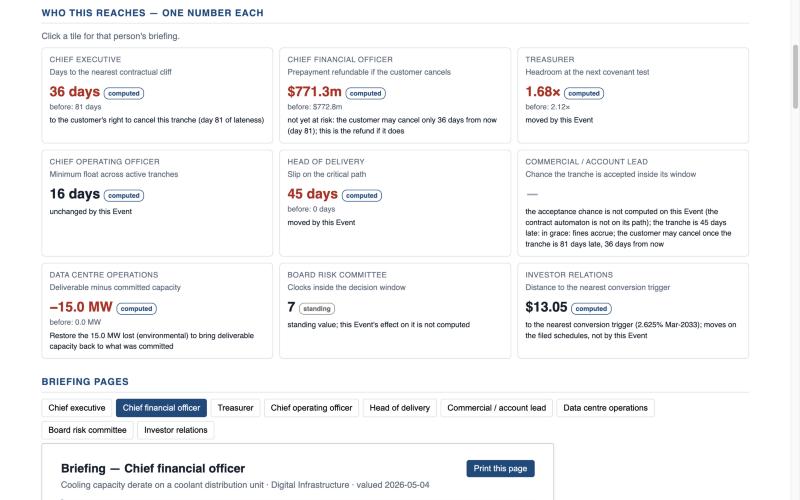
One number each

Nine people. Nine numbers. One run.

The same calculation produces the one number each person needs for their own decision, with what it was before and whether this Event moved it. Because the numbers come from one run, they cannot contradict each other.

EVA's briefing: one number for the chief executive, CFO, treasurer, COO, head of delivery, commercial lead, data-centre operations, board risk committee and investor relations
EVA's briefing for the cooling failure, as the screen shows it: 36 days, $771.3m, 1.68×, 16 days, 45 days, −15.0 MW, 7 clocks, $13.05. The commercial lead's number is shown as not computed on this Event, with the reason, rather than filled in.
The decision window

What each further week of delay costs.

A single number is not enough to decide on. EVA also computes what follows if things get worse, as model runs, not as a probability that hides the cliff.

acceptance window
grace: fines accrue (capped at $3.8m)
the customer may cancel or grant a new date
day 02181 → 180 days late
45 days late
  • fines $1.5m
  • idle power $67.7m
  • loan cover 2.83×
  • headroom 1.68×
Day 81
  • the customer may cancel
  • $769m of prepayment goes back
90 days late
  • fines $3.8m (the cap)
  • idle power $135.4m
  • loan cover 2.39×
  • headroom 1.24×
180 days late
  • idle power $270.9m
  • loan cover 1.51×
  • headroom 0.36×
  • next tranche starts: day 224

What management can do with this on day 0

Restore the 15 MW before acceptance testing, or open the conversation about an updated acceptance date while the customer still has no right to cancel. Tell the treasurer how much covenant headroom each month of delay uses, and investor relations what the market will eventually see. The window for the inexpensive options closes at day 81, not when the quarter's results are reported.

Two views

What management faces, and what the market will see.

An investor never sees the pump. They see the consequences later, in results and in the price of the shares and bonds. EVA computes both views from the same occurrence, on the same set of models.

The operator

For the CEO, CFO, treasurer, COO, delivery, operations and the board. Reads live telemetry and the company's contracts.

  • Capacity 100 → 85 MW
  • Acceptance 45 days late; 36 days to the cliff
  • Fines $1.5m; idle power $67.7m
  • Loan cover 3.27× → 2.83×
The occurrenceCooling lost on a coolant distribution unit
The investor

For investors, lenders, analysts and investor relations. Reads public filings and markets, and values the shares and bonds.

  • Equity, intrinsic: −$3.1m (−$0.01 a share)
  • Secured facility spread 250 → 252 bp
  • Convertible, debt component −$2.4m
  • If the delay reaches 91 days and the customer terminates: −$272.8m

A 45-day delay costs the shareholders almost nothing on paper. The same occurrence, if it is allowed to reach the cancellation right, costs them $272.8m, and the operator's view shows how many days are left to prevent it. The termination line is conditional and not weighted by any probability.

What it plugs into

Your signals and your models in. A number for each person out.

EVA does not replace the systems a company already trusts. It connects what they report to what it means, using the company's own models where they exist.

What goes in

Signals, notices, filings and your own models

Telemetry from building systems, sensors, cameras and microphones, signed at the source. Notices from suppliers, utilities and authorities. Market data and the contract terms in filings. Your analysts' valuation spreadsheet, converted cell by cell into an executable model and checked against the workbook.

Telemetry · Models

Who receives what

One number for each decision-maker

The chief executive, CFO, treasurer, chief operating officer, head of delivery, operations, the board risk committee and investor relations each receive their number, a one-page briefing and a short message. Messages are previewed; nothing is sent except under the organisation's own rules.

Capabilities · Core Systems

What it leaves behind

A record that can be examined

Every figure keeps its model, inputs and evidence, and the run can be replayed to the same result. When the models cannot support a number, EVA says so by name instead of estimating one.

Technology · Evidence

Why the numbers can be relied on

Built to survive examination, not only to persuade.

An executive will act on these numbers, so the rules matter as much as the results.

Same inputs, same numbers

Deterministic models; every run recorded and replayable.

Every figure labelled

Each number says whether it is computed, an assumption, a standing value or conditional.

Refuses rather than guesses

What the models cannot value is named, with the reason, never filled in.

A person confirms

An Event proposed from telemetry fires only when a named person confirms it. No value is produced by a language model.

Beyond data centres

The same engine wherever an event crosses boundaries.

The example above is digital infrastructure. The same discipline already runs on mortgages, capital markets, buildings and insurance, each represented on its own terms, across nine industry domains.

FINANCE · MORTGAGE

One payoff, different positions.

$351,089principal redeemed to the MBS investor−$12,181servicing fee stream that ends
View the mortgage path →
FINANCE · DECISION ANALYTICS

The best immediate action is not always the best policy.

In a forced-sale case, selling a large block at once backfires; over the full horizon, holding is the better policy, and the difference survives a 1,000-path evaluation.

View the decision analysis →
BUILDINGS → INSURANCE

One loss, different bearers.

+$6.55Mbusiness-interruption recovery to the owner−$6.55Mclaim paid by the insurer
View the insurance transfer →
Who is behind it

Built by a risk manager, for the questions boards ask after the fact.

Kindynos was founded by Santa Federico, formerly Global Head of Market Risk at Salomon Smith Barney/Citigroup and Chief Risk Officer of Perry Capital, with a career across Merrill Lynch, Credit Suisse and Ally Financial and roots in physics and engineering.

About Kindynos

One event. Different economic consequences.

Bring one event and the system it happens in.

Describe what has happened, or what may happen, in ordinary language. Kindynos will say what can be computed, what evidence it needs and which decisions the result can inform.